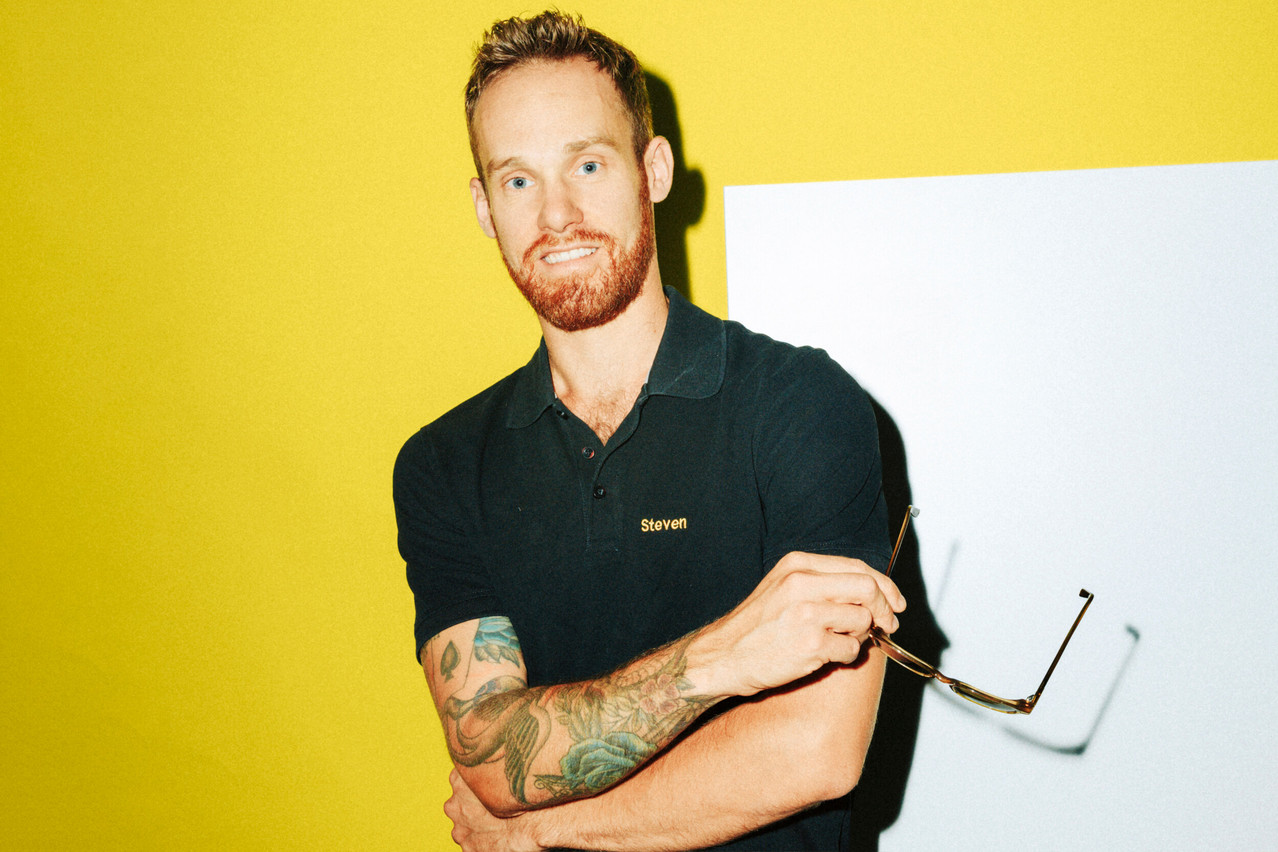
You’re the boss of Rétromobile, a company that’s almost as old as you are?
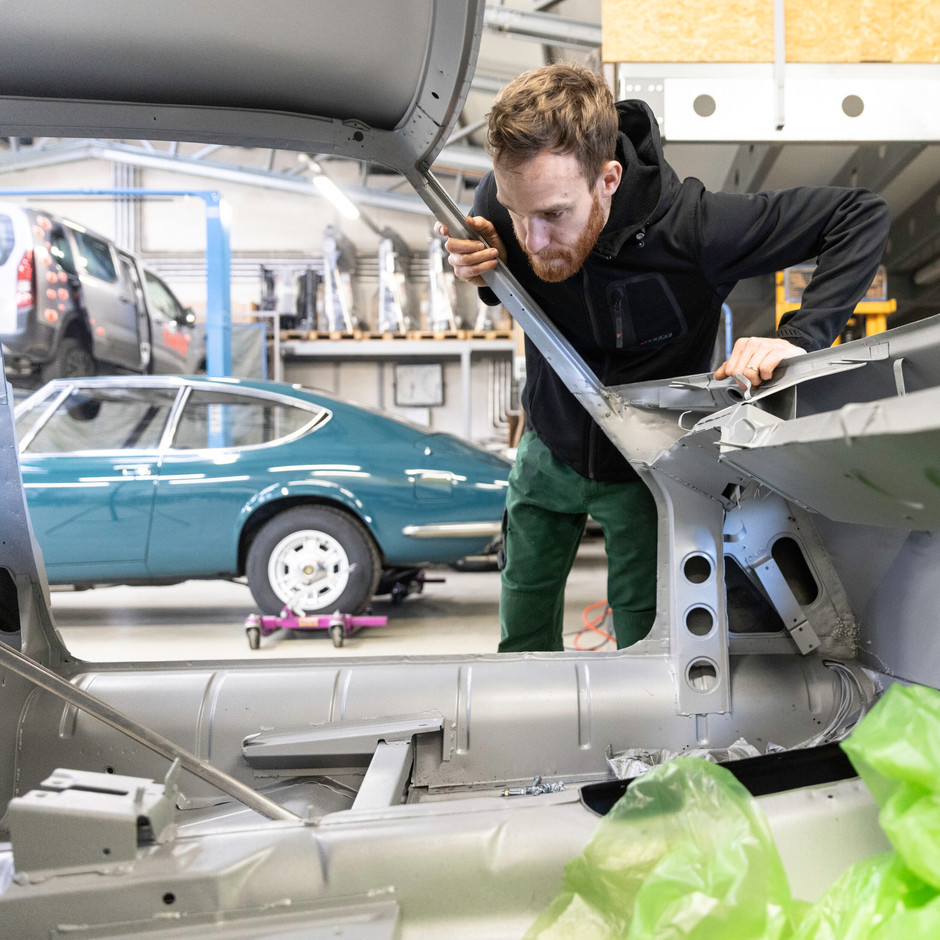
“Yes! To sum up, the company has been in existence since 1990. For a long time, it remained a small-scale business, with just three or four people. I joined nearly nine years ago as a bodywork and paint specialist, to work in the workshop and pursue my passion: working on classic cars. One thing led to another, and I wanted to take on more responsibility. About five years ago, the former owner wanted to retire. He gradually passed on everything I needed to know: responsibilities, staff management, moving between the workshop and the office, orders, and so on. And, for almost two years now, I’ve been running the business entirely on my own. I’ve also decided to double the workforce: we’ve gone from four to eight people, with all that it entails. We’ve stayed in the same premises, but we’ve improved them.
Does moving from the workshop to the boss’s chair make much of a difference?
“Yes! Our company isn’t really like a traditional garage with a lot of hierarchy. There are six people working in the workshop, plus a secretary and myself. There’s no workshop manager or specialist supervisor. This means everyone has to be versatile. Everyone has their own specialism, but must be able to stand in for a colleague who’s off. As there’s no workshop manager, I take on that role myself. Every day I go back and forth between the workshop and the office, sorting out any issues. I’ve chosen to take responsibility for orders, suppliers and customers.
Why this choice?
“Today, I’m lucky enough to have a team whose members get on well and are quite flexible; they don’t have a specific, identical task every day: needs change and we have to accept that. We need to be aware that, in my view, staffing will be the challenge of the coming years. So I take a lot of the burden upon myself; it’s both a strength and a weakness, but at least I have an overview of the whole picture. Perhaps one day I’ll need to find a deputy, but it’s quite difficult to recruit in our specialist field; finding someone who can stand in for me and who knows both classic cars and the adaptation of vehicles for people with disabilities would be even more complicated.
What is the make-up of your team?
“I’m 33. About half the team is younger than me and the rest are older. The oldest is 50. But everyone respects one another; we’ve found a good rhythm and a way to give everyone responsibility. It’s a way of valuing people, entrusting them with a project and showing them that we have faith in them. That’s how I see it.
Five years ago, when your former boss first started talking about leaving, what made you realise?
“It all happened quite naturally. I’d already set myself the goal of one day running a company and not staying in the workshop forever, even though I still enjoy working on cars and painting them. I perhaps didn’t immediately realise the full extent of the responsibilities. It’s only once you’re right in the thick of it that you realise: it’s not just about the work and the invoices. There are the staff, the licences, legal matters, renewals, the accounts, the suppliers… All this behind-the-scenes admin is a huge burden. At the start, when you reach this level on your own, you only see a small part of the picture. Now, I have a view of the whole picture, of the entire company, right down to the very end. And that’s when you realise: there’s a lot to it.
How do you get used to it?
“We learn new things every day and we have to constantly challenge ourselves. Mentally, it can be very difficult; there’s a reason why not everyone wants to do it. But it’s hugely satisfying when the company runs smoothly, when we hear positive feedback and when our efforts pay off. This year, for example, we’ve almost doubled the number of appointments compared with last year and had very few complaints. We’re gradually introducing certain management methods, whilst remaining a small, family-run business with a culture that’s still quite traditional. You can’t change everyone’s mindset overnight.
Do you manage to strike a balance between your private life and your life as a boss?
“I have two young children. You have to find a balance – it’s something entrepreneurs perhaps don’t always talk about. Back then, when I heard entrepreneurs giving speeches thanking their partners or families even though they weren’t actually working in the business, I didn’t really understand it. Now I do: they are the ones who shoulder the burden of everything we subsequently give back to society.
There are human stories behind them. That’s really what keeps us motivated to carry on working, despite the complications.

Rétromobile is best known for the maintenance of classic cars, but is that its only activity?
“In fact, a distinction must be made between two areas of business within the same company and under the same name. The company started out with classic cars, then moved into vehicle conversion a good 20 years ago, because this service was virtually non-existent in Luxembourg. We were amongst the first to offer solutions in collaboration with various partners. Other providers exist today, but they are not as specialised as we are. The other line of business is the maintenance of classic cars. The choice of word is important: people often talk about restoration, but our main mission is to maintain the cars on the road in Luxembourg so that they can continue to run. This includes mechanical work, as well as paintwork and bodywork, to ensure they remain in good condition and do not deteriorate. We do carry out restorations from time to time, but less and less so. Our role is really to preserve Luxembourg’s motoring heritage. Both activities are brought together under the name Rétromobile: ‘retro’ and ‘mobility’. We recently added ‘Luxembourg’ to the name to affirm our identity. Although we have a few Belgian or French customers, our work is carried out here, in our workshop, for Luxembourg. That’s very important today.
What is it about all this that you really like?
“Most of our projects come not from collectors looking for a specific model, but from people who have an emotional attachment to the vehicle. There are human stories behind them. That’s really what keeps us motivated to carry on, despite the complications. Driving a classic car in Luxembourg isn’t always easy: the heat, a lack of time and other leisure activities mean that owners drive them less often.
How are the two activities divided up?
“Across our two areas of business, the adaptation of vehicles for people with disabilities now accounts for more than just classic cars. Previously, classic cars dominated; today, we’re close to a 50-50 split, with adaptations for people with disabilities slightly in the lead. This is important for the company’s stability. It is also a service that needs to be promoted more, as there are real gaps in the market in Luxembourg and demand is growing.”
This article was written for the October 2026 issue of Paperjam magazine, published on 16 September. The content is produced exclusively for the magazine. It is published on the site to contribute to Paperjam’s comprehensive archive. Click on this link to subscribe to the magazine.
Is your company a member of the Paperjam Club? You can request a subscription in your name. Please let us know via club@paperjam.lu.