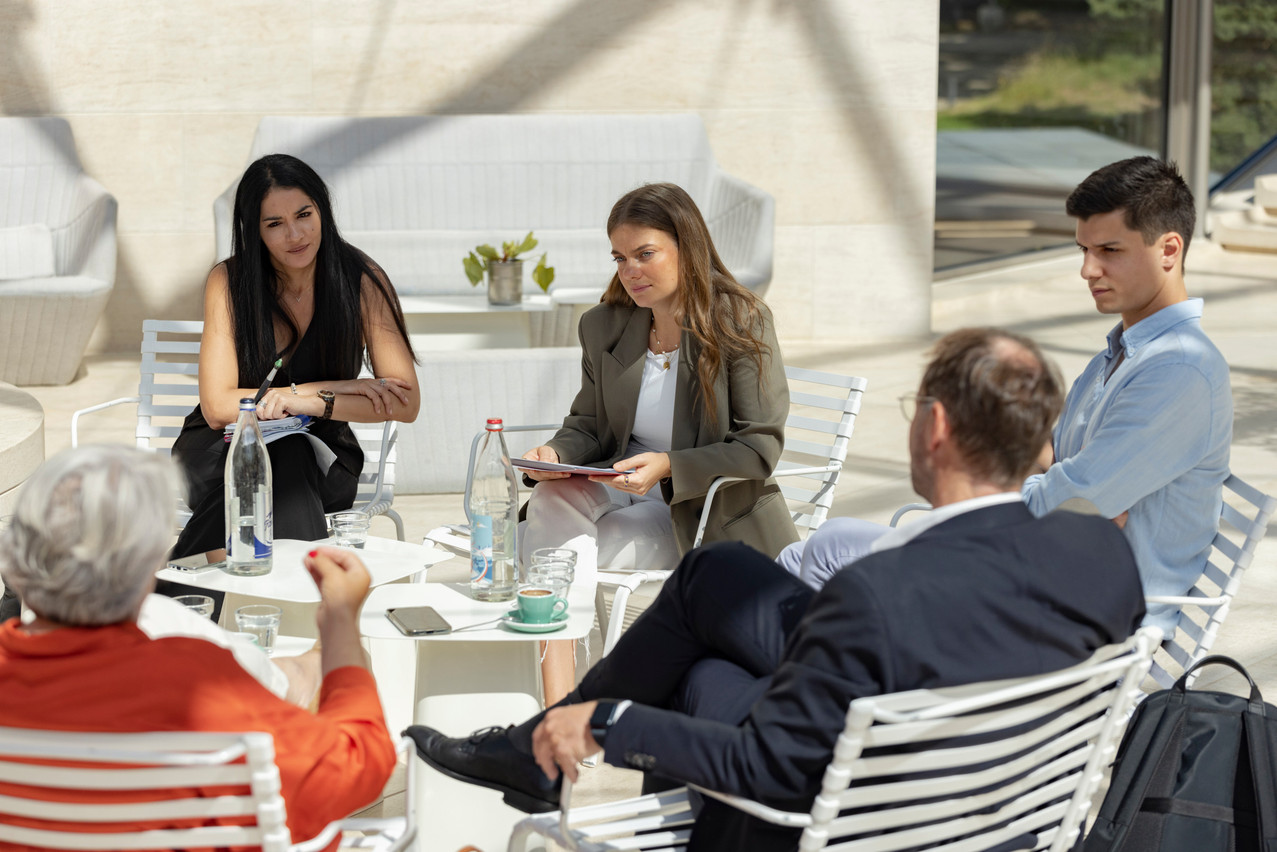
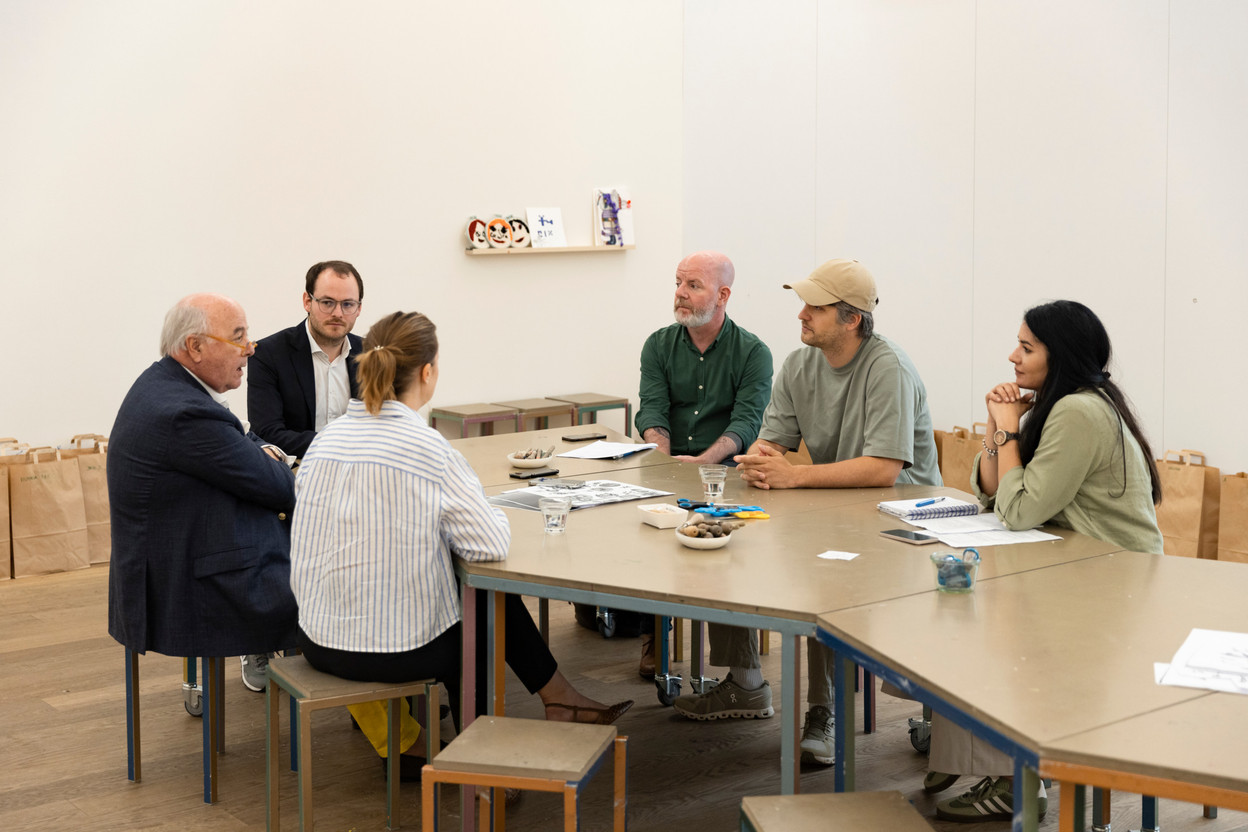
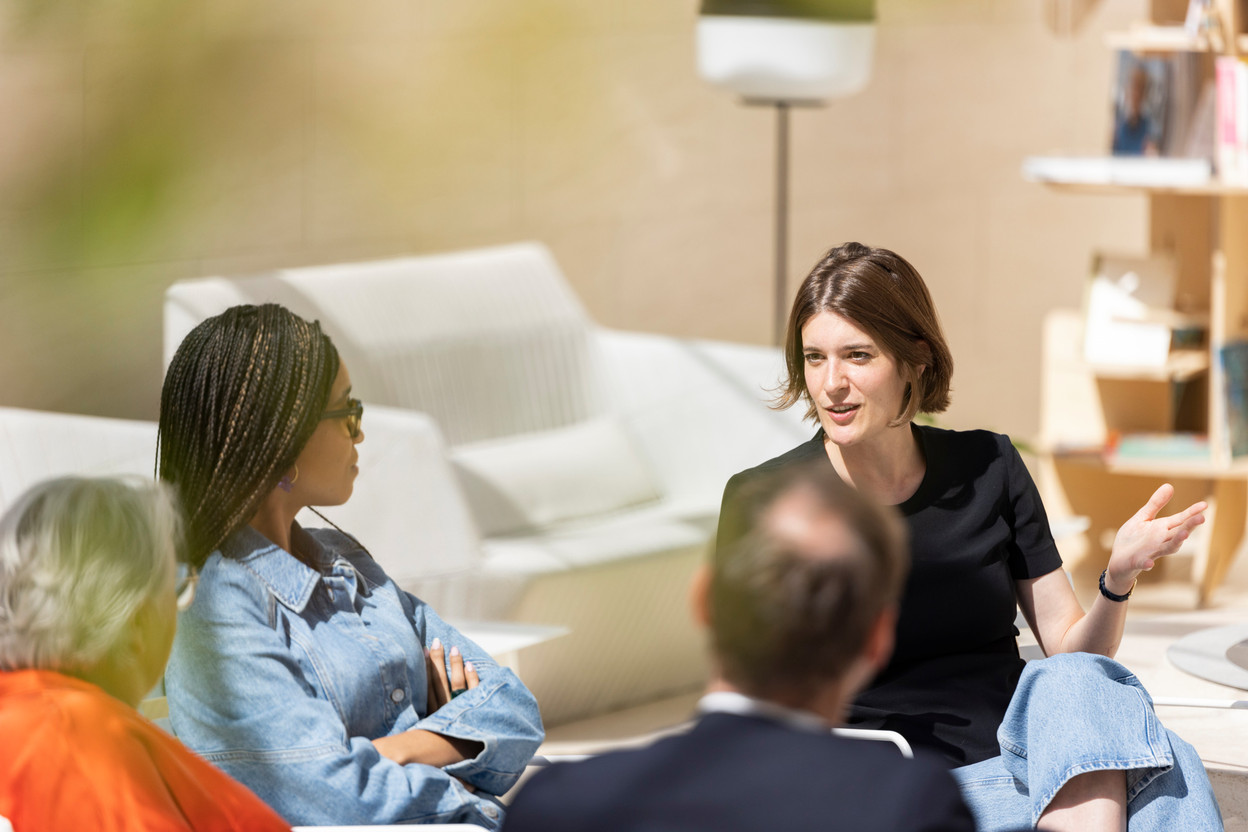
New outlook, new perspectives. Another generation is taking charge of the country with the accession to the throne of the Hereditary Grand Duke William on 3 October. A well-prepared transition, built over time: like a metaphor for the intergenerational mix that the country as a whole must foster to meet the challenges of the future. Paperjam brought three generations together around a table at Mudam to discuss these major issues. More sustainable growth, a reinvented world of work, new technologies... Fourteen players from various sectors of activity crossed their views on the Luxembourg of tomorrow.
Nation branding
 Maxime Allard: "Even in the private sector, Luxembourgers are not always very good at communicating their strengths to the outside world, because of a certain humility. We have champions in gastronomy, tech and research, and we should be showcasing them much more. That would attract even more talent. We also have every interest in identifying niches and positioning ourselves in them. We've done it in finance and space, notably with SES. Today, thanks to digitalisation, we have the opportunity to choose niches. We can also become successful when it comes to AI linked to the financial sector, since we're already very good at financials."
 Marie-Jeanne Chèvremont: "We really need to choose a line of niches and communicate better about them. Not just outside the country, but also in Luxembourg. I think it's a big mistake we've made in the financial sector: the sector has developed without the public always understanding what's going on. We are not didactic enough."
 Norbert Becker: "Ireland has a single agency called IDA, Irish Foreign Direct Development Agency. It covers all the industrial and financial sectors, etc., and records everything that's going on. We have Luxembourg for Finance, we have Fedil, we have the Chamber of Commerce, we have the Chamber of Trades... They all do their own thing, but it's not consolidated. And so it lacks weight. A single body would be desirable."
 Paul Ernster: "Personally, I dream of a Luxembourg where we work together. We need to grow. As Norbert said, there are so many institutions, I have the impression that they are pulling in all sorts of directions. They're all in Kirchberg, but there you go..."
 Philippe Harles: "What we must avoid at all costs is resting on our laurels. Why did the files come in? Why have organisations turned to Luxembourg? Because we've done an enormous amount of work over the last few decades to position ourselves, to listen to foreigners. We can't stop there. We have to get out there every day, explain things, reinvent ourselves, reposition ourselves, forge links, have ambassadors..."
Society
 Lise Roda: "The transition must be based on the ability to offer a quality of life and a living environment. Where I'm very optimistic is with people. It's not a whim on their part to want to have several employers. It's a response to a reality, that of a fragmented world, with geopolitical issues that change almost from week to week, that change every pack of cards we hold in our hands. Employees don't belong to anyone, they belong to a goal, to a wider vision. Between now and 2050, I think we really need to move towards decompartmentalisation and work collectively towards these ambitions. Even if we are all competitors in the economic ecosystem, we share the same interests."
 Raymond Schadeck: "Luxembourg has a huge opportunity to become a leading country in terms of sustainability. In ESG, we also need to work on the 'S'. For example, indexation of salaries... Furthermore, Luxembourg is in a unique situation. More than 70% of the people who create Luxembourg's GDP do not have the right to vote at national level. Maybe all the politicians will talk about 2050, but the priority is to be re-elected in 3 years' time. That's where I think the federations have a huge role to play. They are supposed to compensate for this democratic imbalance."
 Jana Degrott: "We mustn't forget other sectors, such as social and healthcare, for which we need to become even more attractive. Our population is ageing - and will continue to age - and we already have a shortage of staff. These are well-paid profiles, but we need to attract even more professionals, to show that the working conditions are good."
Multiculturalism
 Jens Kreisel: "The University is naturally oriented towards the future. As researchers, our horizon is always 10 or 20 years ahead. For Luxembourg too, we have to look ahead to what will happen in 10 or 20 years' time. At the moment, we're lucky enough to be welcoming a number of companies, which is testament to our attractiveness. But the real question is how can we ensure that these companies will still be here in 10 or 20 years' time? We need to prepare now. Luxembourg's attractiveness and advantages can be seen at university, where 70% of our graduates stay on. In other 'normal' university towns, the figure is 30%. But it's not the university, it's Luxembourg that keeps people here, because there's work to be had, because you can imagine your children growing up here, because they'll almost suddenly become quadrilingual! We need to preserve that while continuing to think about points of attraction."
Anne van Wetteren: "When you're abroad and you say that in Luxembourg you speak four languages, everyone is speechless! It's a huge asset, even if we tend to think it's perfectly normal. But it could make us the coolest, most open country in Europe! Our slogan says 'Let's make it happen', but until now, I still haven't figured out what!"
Housing
Marie-Jeanne Chèvremont (MJC): "Housing is a big issue. With two major issues: its cost and the question of access."
Anne van Wetteren: "People come here to earn a better living and end up sharing flats with 12 other people, at the age of 30! We do indeed have a shortage of housing, with prices going in all directions. We really need to get a handle on this. But today, the rule seems to be to invest in defence... That's going to represent how many billions that won't be invested in concrete things, here, like housing?"
Jana Degrott: "This puts the brakes on young people taking risks. Local authorities have already started to work on this issue, offering, for example, more flexible housing, such as intergenerational living. More broadly, this helps to promote an environment that is conducive to entrepreneurship and risk-taking, without being held back by the fear of losing one's home. I was once in this situation. I had a project that required a full-time job, but which didn't allow me to pay for accommodation. I moved to Berlin because it wasn't possible here. We really need to work on that."
Attractiveness
Norbert Becker: "There are going to be some very important changes with what's happening in the political theatre and that's why we're obliged to have growth, to do better, to make the right decisions, but also to do what research centres do: we have to be able to test ideas and accept that not all of them are going to work straight away. And then, the really big issue is that there isn't enough investment capital to support companies like Letz AI or Cocottes. Although we are very, very rich, Luxembourgers are very reticent as investors. They prefer to put their money in the Spuerkeess rather than invest in companies. It's a whole education that needs to be done."
 Clémentine Venck: "By 2050, we'll be on the million inhabitant mark. For that to happen, we need growth, and we need to adapt our infrastructure, both housing and transport. But also the jobs. We need to keep it sexy to come and work here. We need to be on top of these new technologies, and especially the mega-trends that have been mentioned. There is also an absolute need for crafts. In our craft trades - as we're seeing more and more with the development of technology and AI - there's a growing demand for experience. We really need to reinforce this, using these digital tools to support the human element first and foremost, so that we can make our teams shine and deliver a maximum experience. These peak moments are what make us feel alive. And that's what we create ourselves in our banners and in our brands."
 François Mousel: "It's hard to say exactly where Luxembourg will be in 2050. I think we need to work hard on all the ingredients that contribute to success: encouraging curiosity, raising awareness of the private economy from school onwards, working on the differences between civil servants and the private sector, acting on that, attracting the right talent... All this basis of curiosity and innovation that will ensure that if the world changes, we will change with the world."
Philippe Harles: "What makes Luxembourg strong is pragmatism. I hope that in 2050, stability, innovation and pragmatism will still be in place here because that's what sets us apart from other jurisdictions. We'll also have to see how the European Union develops, because Luxembourg without the EU will lose quite a bit of its attractiveness. In short, I'm less worried about Luxembourg than I am about the direction of the EU, which will also have an impact on the country."
250,000
According to the IGSS, on 30 April 2025 (the latest figures available), Luxembourg had 234,024 cross-border workers. These workers account for almost half of all salaried employment, the majority coming from France (126,000), followed by Belgium and Germany (around 52,000 each), according to Statec. The trend is unlikely to be reversed, with the institute predicting that the 250,000 mark will be reached by 2026, with more than half of the new jobs being filled by cross-border workers...
This article was written for Paperjam magazine for the month of October 2025, published on 24 September. The content is produced exclusively for the magazine. It is published on the site to contribute to Paperjam's comprehensive archive. Click this link to subscribe to the magazine.
Is your company a member of Club Paperjam? You can request a subscription in your name. Let us know via club@paperjam.lu