
Signals confirming a gradual de-escalation in the trade dispute between the United States and the rest of the world have reassured investors. In the wake of an initial agreement signed between the United States and Great Britain, concrete results have also emerged from discussions between American and Chinese representatives. These led to a significant reduction in reciprocal tariffs for a period of 90 days, marking the lifting of the de facto embargo on trade between the two countries. The reciprocal rate--to which existing tariffs are added--applied by the United States on Chinese imports has fallen from 145% to 30% (including the 20% decreed in March by the US president as a sanction in the fight against fentanyl trafficking) and the rate applied by China on US imports has gone to 10% from 125% previously.
This easing of tensions is positive, as it is likely to limit the economic damage caused by the protectionist measures adopted by the Trump administration. However, the first damage is already visible on the economic front: a boom in US imports in the first quarter, confidence indicators at half-mast and increased volatility on the currency front.
A contraction in activity during the first quarter
The contraction in US activity needs to be put into perspective (-0.3% at an annualised quarterly rate). It can be explained by the very sharp rise in imports, particularly of goods (+50.9%), in anticipation of the application of customs duties. Many US companies imported on a massive scale in order to replenish their stocks and avoid the increased costs associated with higher tariffs. The much more moderate growth in exports (+1.8%) was unable to offset the explosion in imports, resulting in a record negative contribution from foreign trade to US growth (-4.8%). Given the significant rebuilding of inventories seen during the quarter, the trade balance should be less of a drag on US economic momentum over the coming quarters.
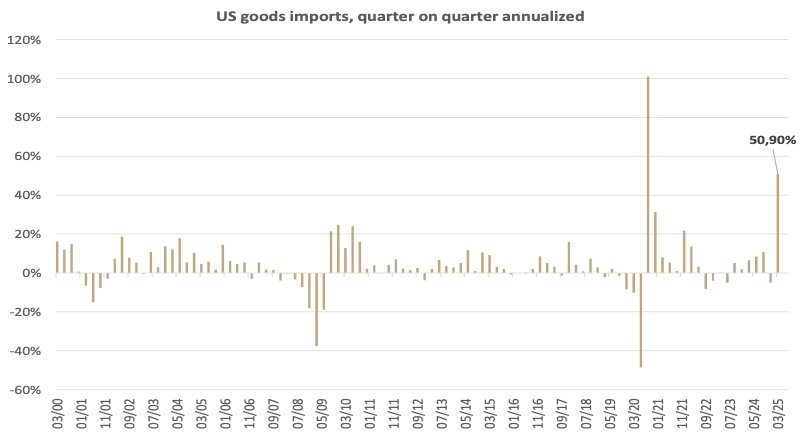
US imports of goods, quarter by quarter, annualised. Source: BEA, Banque de Luxembourg
Confidence indicators still at half-mast
Confidence indicators continued to fall in April, particularly at the US consumer level. It is mainly the future components of the various surveys that are deteriorating. Will the sharp fall in these indices ultimately be reflected in economic data, particularly household consumption? Although still rising, household spending already slowed slightly (by 1.8% at an annualised quarterly rate) during the first three months of the year. Retail sales for April confirm this trend of a less expensive consumer at the start of the second quarter.
Substantial movements on the currency front
The dollar has weakened significantly against the main currencies of the United States’s trading partners. It has lost almost 8% since the start of the year. There have been substantial movements, particularly against Asian currencies. The Taiwanese dollar, for example, appreciated by around 7% against the greenback in the space of two trading sessions in early May. A massive move over a very short period of time based in particular on speculation that a trade agreement between the United States and Taiwan would include the need for a revaluation of the Taiwanese currency.
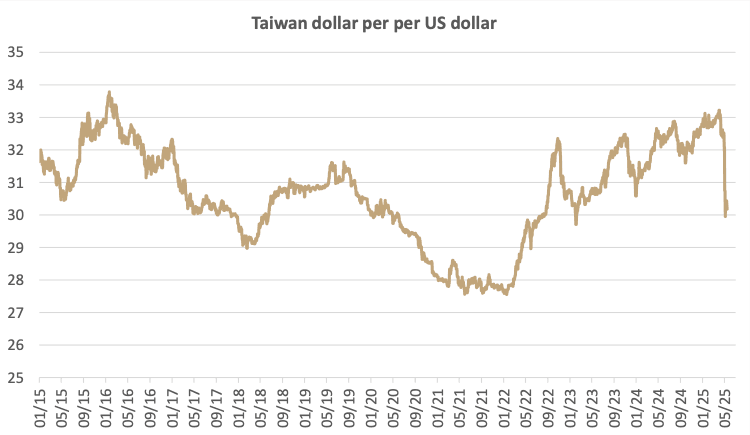
Taiwanese dollar per US dollar. Source: Bloomberg, Banque de Luxembourg
In addition, local financial players--such as insurers or even exporting companies--heavily exposed to the US dollar in order to benefit in particular from a favourable interest differential, have probably accentuated the upward movement by selling or hedging part of their exposure to the US currency.
Excessive optimism in the equity markets?
While the prospects for an increase in trade agreements are encouraging, it seems certain that the rate of tariffs on imports into the US will not fall below 10%. At present, in the light of recent announcements, the average rate is 15%, down from 25% in April but still six times higher than at the end of 2024! Against this backdrop, it seems unrealistic to expect that there will be no negative impact on the economy or on corporate profits. The strong rebound in the equity markets therefore appears to be based on considerable optimism.
This article was originally published in French.