*In early 2023, Paperjam's editorial team isolated ten themes from the Frieden-Bettel government's coalition programme. After a year spent taking stock of government action, here is the second phase of the Polit-Radar.
1. What is the government's vision for ecological transitions and how is it translated into national start-ups?
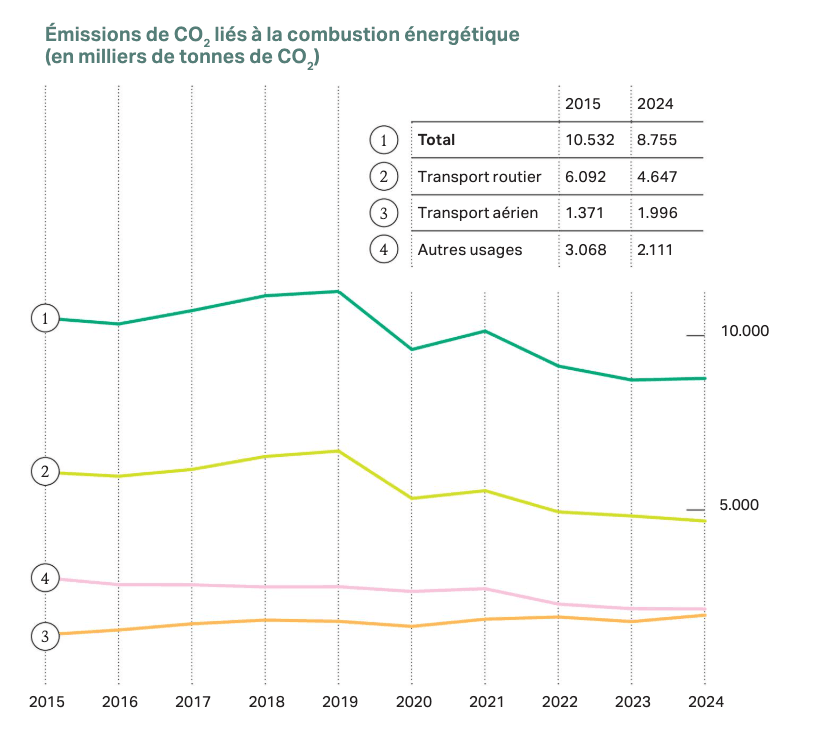
The government's ecological and energy transition policy pursues three objectives: sovereignty and security of supply, economic competitiveness and reducing CO₂ emissions. This is a cross-cutting policy that covers energy and energy consumption, as well as preserving biodiversity and adapting to climate change, with quantified targets. To achieve them, the executive is defending a pragmatic approach, in collaboration with industry and citizens. The central document of this policy is the National Energy-Climate Plan (Pnec), updated last summer.
"An ambitious plan", according to Economy Minister Lex Delles (DP), which envisages a 55% reduction in greenhouse gas emissions by 2030 compared with 2007, a 37% share of renewable energy in gross final energy consumption by 2030, and a 42% improvement in energy efficiency. These are all intermediate steps towards achieving climate neutrality by 2050. In addition, in February, Minister for the Environment, Climate and Biodiversity Serge Wilmes (CSV) presented the Draft Strategy for Adaptation to Climate Change, which is also based on a participatory approach and sets out 131 measures in 16 policy areas, again using a cross-cutting approach.
(Source: Statec)
2.7 billion euros
Gilles Roth, Minister of Finance (CSV): "The 2025 budget allocates €2.7 billion to achieving the objectives of the Pnec. This amount will be increased to €2.86 billion in 2028."
2. What levers is the government using to achieve its objectives?
To achieve its objectives, the government is counting on administrative simplification to speed up projects and on incentives for businesses and individuals, including the "Klimabonus Wunnen" and "Mobilitéit". This is the government's philosophy: to encourage rather than coerce. As soon as it took office, the Executive extended until the end of June 2024 the aid scheme to promote sustainability, the rational use of energy and renewable energies in housing (Klimabonus Wunnen) and mobility (Klimabonus Mobilitéit). This aid has since been further extended and adjusted to better integrate the social dimension, in particular with the tripling of the energy bonus.
Schemes are multiplying: one example is the bill (currently in committee) on the transition to a net zero emission economy, which introduces new aid designed to provide financial support for companies implementing projects linked to Luxembourg's ecological and energy transition, such as decarbonisation, energy efficiency or renewable energy production. Planned amount: €420 million. The State has also supported the installation of 232 electric charging points by businesses, 124 of which will be freely accessible. Cost: €2.4 million. Another key measure is the stabilisation of electricity prices. With the end of the price cap, the State budget will cover part of the network costs. The aim is to keep electricity prices below the European average and stabilise them for the long term, without a return to the price cap. Envelope: €150 million.
(Source: Statec)
30%
Electricity prices for households in Luxembourg are expected to rise by an average of 30% in 2025, due to the partial abolition of the support measures introduced at the end of 2022, according to Statec. If these measures had disappeared altogether, the increase would have been around 60%.
3. What concrete progress has been made and how is it being measured?
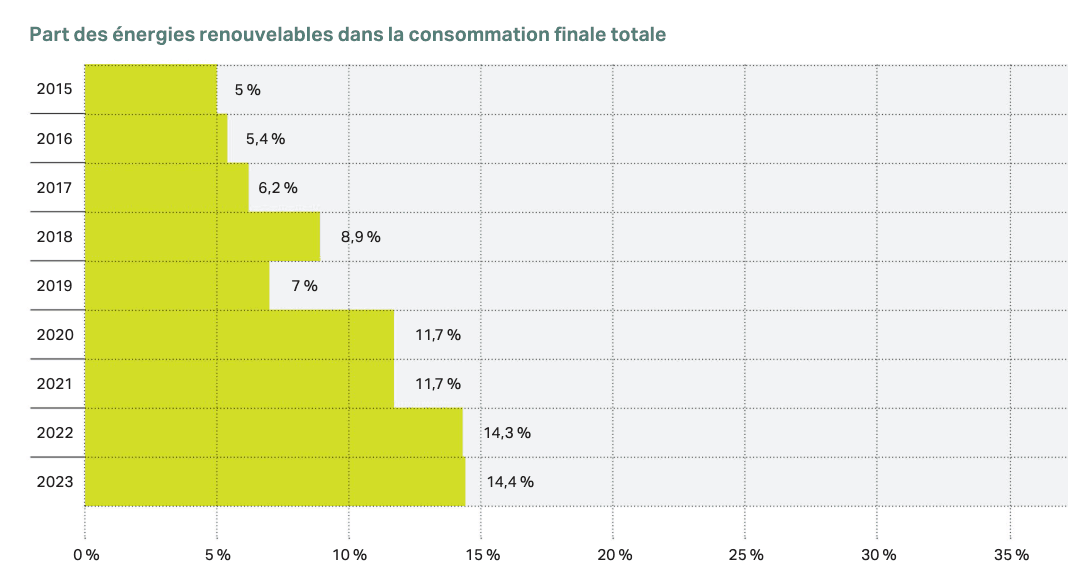
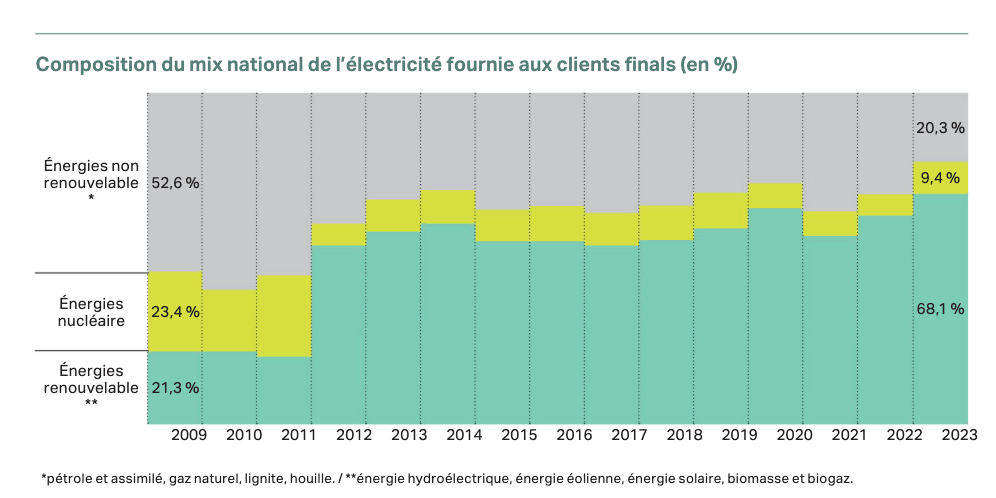
To date, the country is on a favourable trajectory. In its latest economic report, the statistical office forecasts a 4.5% fall in greenhouse gas emissions in 2025 and a 5% fall in 2026. According to Statec, "this trend would enable Luxembourg to remain in line with the objectives of the Pnec". As for the share of renewable energies in energy consumption, it should reach 16% in 2024 and 22% in 2025.
Although Luxembourg remains heavily dependent on electricity imports (78% of its consumption in 2023, according to Statec), domestic production is gaining in importance and is increasingly oriented towards decarbonised sources. This trend is being driven primarily by the development of photovoltaic and wind power. Since 2014, the number of solar installations has almost doubled (from 14,000 to 23,000 by 2024). In 2024 alone, 8,000 new installations of this type were commissioned, providing green energy to almost 30,000 homes (+60% in terms of installations and +40% in terms of capacity).
To speed up the movement, a bill has been tabled to allow pre-financing of these installations, based on the third-party payment model. The government also wants to promote green hydrogen and has adopted the legal basis for the deployment of such a network, with the ambition of connecting the country to the international network. It has invested €39 million in the LuxHyVal project, dubbed the "Luxembourg Hydrogen Valley", with the aim of producing up to 1.750 kg of green hydrogen per day in Bascharage from 2026. The executive has also invested in Echo-Wave, a project led by H2 Energiewiss Kielen, a Luxembourg company founded in February 2025.
(Source: Statec)
87.1%
Developing renewable energy is also a way of reducing the country's still high energy dependency. Luxembourg is 87.1% dependent on foreign countries for its energy consumption (compared with 93.1% in 2015).
4. How is the government arbitrating between the need to protect the environment and the desire to simplify procedures to speed up projects?
In a government that puts housing in particular and the economy in general first, is the environment the poor relation of government policy?
The opposition, led by Déi Gréng and the LSAP, is at least convinced of this. On 25 January, when Economy Minister Lex Delles (CSV), Housing Minister Claude Meisch (DP) and Environment Minister Serge Wilmes (CSV) presented the new rules on affordable housing and town planning for business parks, there was also talk of simplifying environmental rules.
However, this last point, like the presence of Serge Wilmes, seemed more a matter of symbol than action. He did, however, announce the harmonisation of environmental investigation procedures. This concerns legislation relating to environmental impact assessment, classified establishments ("commode"), water management and the protection of nature and natural resources. At the same time, a wide-ranging consultation has been launched with players in the sector and local authorities to simplify the rules and speed up the deployment of renewable energies.
Baptised "Einfach, séier, erneierbar", this consultation has produced a catalogue of 50 measures, which will give rise in the coming months to various bills amending certain existing legislation. These measures include the introduction of "bagatelle limits" (no authorisation or simple notification for small projects), the reduction of time limits and digitisation of procedures, the acceleration of appeals against major projects, the installation of photovoltaic panels on protected buildings and along motorways, new rules for the construction of wind turbines and the development of a national electricity storage strategy.
Source: Statec)
February 17
As the passing date in 2024 in Luxembourg. It symbolises the moment when the country has consumed all the resources that the Earth can regenerate for the current year. This date has remained relatively stable over the last ten years. Conversely, that of the planet has risen from 13 August in 2015 to 24 July in 2024.
This article was written for Paperjam magazine for the month of October 2025, published on 24 September. The content is produced exclusively for the magazine. It is published on the site to contribute to Paperjam's comprehensive archive.
Click on this link to subscribe to the magazine.
Is your company a member of Club Paperjam? You can request a subscription in your name. Let us know via club@paperjam.lu