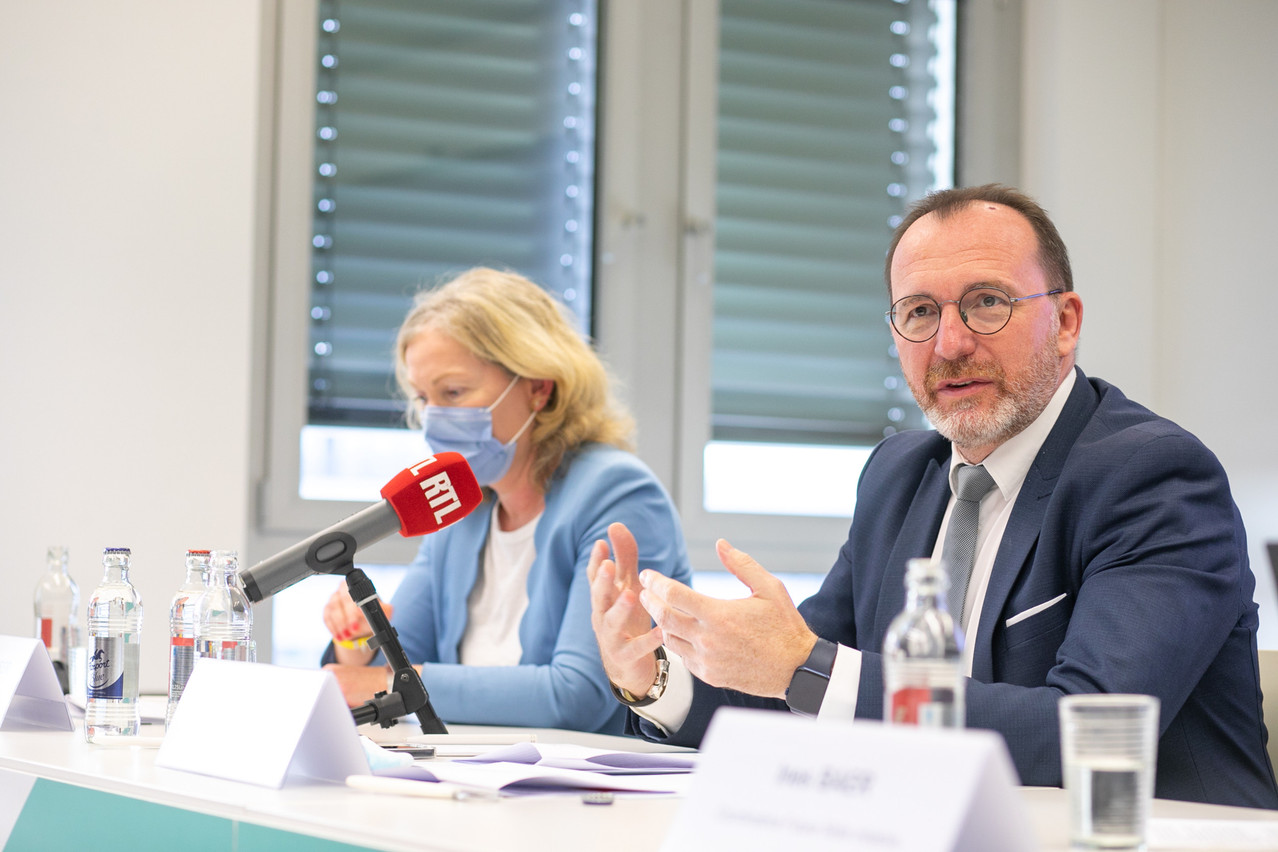
On 20 January, Engel made his first official appearance as the new labour minister at Adem's press conference during which Luxembourg's employment agency presented the results of its latest study on the job market over the last six years.
Adem's figures indicated a continued decrease in unemployment. “I can of course only be pleased that unemployment is now at a level it has not been since the beginning of 2019. But I also know for a fact that I had nothing to do with it,” said Engel in reaction to that.
During the handover ceremony of the labour minister post you made a point of emphasising that “the initiatives taken by the government in the field of labour and employment had made it possible to save thousands of jobs”. Do you consider that the bulk of the crisis is now behind us?
Georges Engel - “Partial unemployment has indeed helped us. But we are still clearly in this crisis today. And we have to bear in mind that the post-crisis period will also be very complicated to manage. Because the companies that we have helped during the crisis will not be out of the woods. We will have to remain vigilant about the unemployment rate, but also about the skills that job seekers and companies will need, and the training that will have to be offered.”
We will also have to see how to organise vocational education in the future. And then there is also the issue of digital platform workers and the digital economy. As you can see, I am not going to be idle.

What are your priorities for the nearly two years in which you will be at the helm of the labour ministry?
“Several bills were tabled by my predecessor and will have to be accompanied. The one on the right to disconnect, but also the one on bullying.
But there are still other projects to come, paternity leave for the self-employed, for example, and for same-sex couples. These laws would be the logical continuation of what we have already put in place in this area. These are people who also have children and are entitled to the same treatment.
We will also have to see how to organise vocational education in the future. And then there is also the issue of digital platform workers and the digital economy. As you can see, I am not going to be idle.”
What is your point of view on this last dossier, the digital platform workers?
“Discussions are still ongoing. There was even talk of creating a third status, alongside employees and the self-employed. This would be somewhere between the two. Personally, I am not too much in favour of this. This third status would run the risk of seeing a lot of problems emerge, while having less social coverage.”
You also mentioned vocational education. Isn't this the biggest challenge in the field of work for the years to come in Luxembourg?
“It is the biggest challenge for everyone, not just for us. We saw again in the study presented this Thursday by Adem that one of the skills most in demand on the job market is adapting to new situations, to changes. In the past, you graduated at the age of 20 and worked for the next 45 years in the same place without needing further training. Those days are gone. You can see this clearly when you look at everything to do with technology, with computers. Every six months, a new major change appears.
Luxembourg is a country where the number of vacancies has always been high. If I refer to the latest figures from this Thursday, there were more than 10,000 as of 31 December, for 16,403 job seekers. You would think that matching these two populations should be fairly straightforward. However, this is not the case. Hence the need to create training for jobseekers, to set up continuous training and to have a study like the one carried out by Adem in recent months to help us.”
This story was first published in French on Paperjam. It has been translated and edited for Delano.

