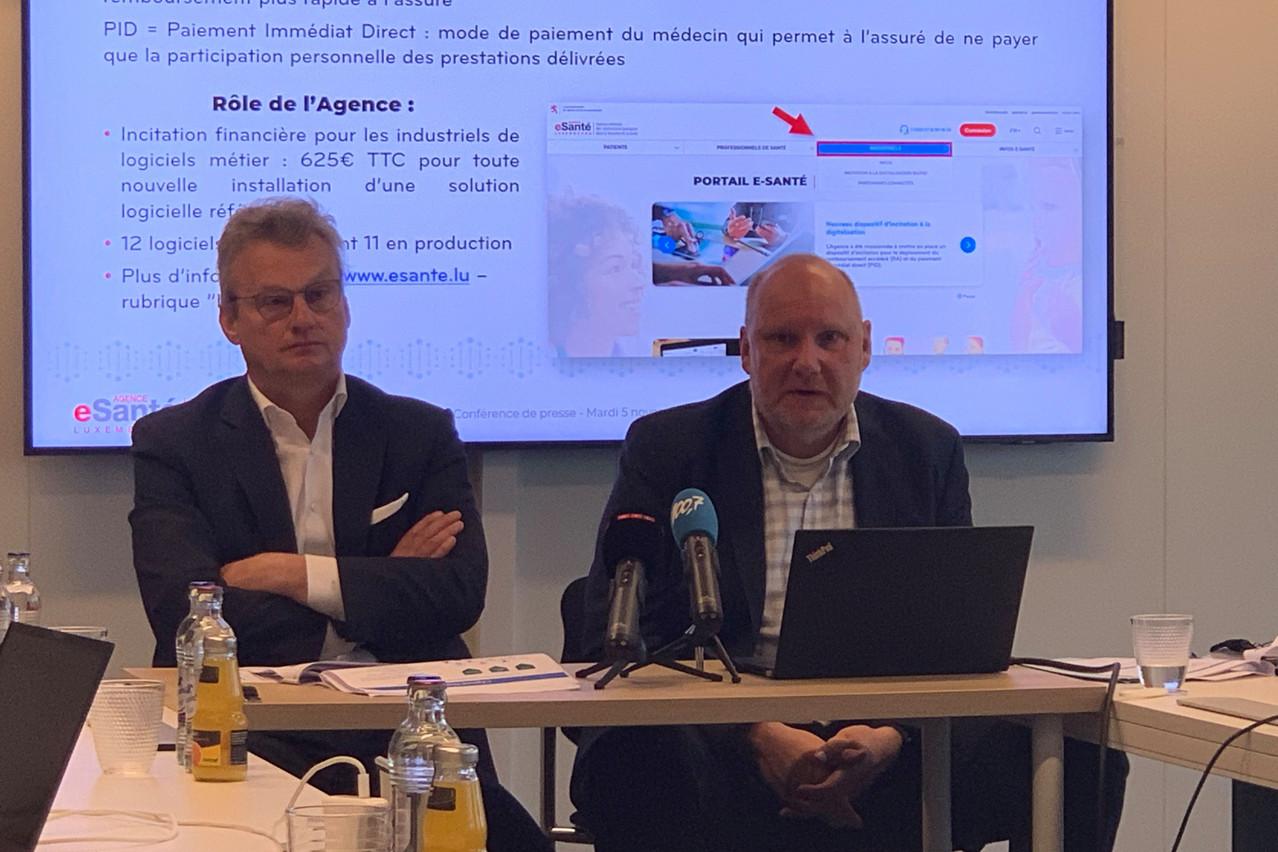
The years go by, but the way we talk about it remains the same. Shared electronic healthcare records (dossier de soins partagé, or DSP), launched in 2020 to centralise patients’ medical information online, “continues to be deployed,” according to the chairman of the management board, Marc Hostert, and the chief executive officer, Ian Tewes. As of 30 September, 1.2m DSPs were activated, of which only 0.18% had been closed. The agency considers this rate to be “low,” and sees it as a sign of public support. But only 65.2% of files--782,400 files, to be precise--contain at least one document. In other words, more than 400,000 files are empty. Why is this? Lack of information? Reluctance on the part of patients to share their data? Lack of digital skills?
When asked about this, Hostert explains that “a DSP is automatically created for every person born in Luxembourg.” Before adding, “and every time a person is treated in a hospital, whether they are a visitor or a resident, a file is created.” This would explain why the agency has 201,664 patient accounts--there were 672,000 residents on 1 January--but almost six times as many files.
So, are there many DSPs that are no longer up-to-date? “No, on the contrary," says Hostert. “This is a frequent occurrence in Luxembourg with expatriates and cross-border commuters. The files still exist and when they return to the country, they can retrieve their data thanks to the EHDS (European Health Data Space) and can add the information they obtained when they were treated abroad.”
13.7m documents
Today, all DSPs in total contain around 13.7m documents, an average of 11.4 documents per file. “Stopping the reproduction of medical images on CD in 2024 has clearly had a positive impact on the adoption of this tool by healthcare professionals,” says Hostert, “The growth in the use of the DSP is also due to the filing of new types of documents.”
Patients consult these documents almost eight times as often as the 3,807 healthcare professionals.
The electronic vaccination record, integrated into the DSP, is a cornerstone of this, for example: in September 2024, the agency counted 45,952 digital vaccination records. “It’s a tool that makes life easier, thanks in particular to the automatic vaccine reminders sent to patients.”
“Digitalisation should simplify the lives of patients while making the work of healthcare professionals easier.” And for those who are less at ease with digital technology, traditional solutions remain accessible. “There is no discrimination,” says Hostert, although he acknowledges that the DSP is mainly used for people who are ill or at the start of their careers.
“We’re not talking here about writing a university dissertation”
The digitalisation of the healthcare sector, while essential, also raises legitimate concerns about cyber security and data theft. “Together with the National Commission for Data Protection (CNPD), we are keeping a close eye on this and making sure that our systems are in concrete and meet the most stringent standards, in particular those set out in article 60ter of the Social Security Code,” assures the chairman of the management board.
To achieve this, the agency plans to set up a security operations centre (SOC) by the end of the year. This platform will enable the security of the healthcare ecosystem’s information systems to be supervised and administered using tools for collecting and correlating events and intervening remotely.
“This is vital, but we shouldn't be afraid of digitisation: in a traditional practice, it's already possible to rummage through a drawer and steal information. With digitalisation, these data thefts are simply taking place on a larger scale,” says Hostert.
Technology is synonymous with artificial intelligence. On this subject, he tempers expectations: “Let's already do what's on the table. It's true that AI will play an important role in tomorrow's medicine, but there are legal questions that need to be answered. We're not talking about writing a university dissertation here; when you process health data, it has to be robust.”
This article was originally published in French.