Will Europe's minimum wage directive see the light of day? This directive, adopted in November 2022, aims to develop collective bargaining in countries where less than 80% of workers are covered by an agreement and to set a framework for the development of "adequate minimum wages". Its transposition in Luxembourg, via two different bills, had marked the start of direct confrontation between the government, with its Labour Minister 
A court referred to by Denmark, supported by Sweden, because both feared that the text would lead to a weakening of their social models, in which wages are set by collective bargaining without State intervention. On 10 February this year, the Advocate General took the view that the directive should be annulled on the grounds that it is not for the European Parliament and the Council of the European Union to decide on how pay is set.
The budget issue will also be on the agenda of the European institutions. This Friday 14 November sees the meeting of the Conciliation Committee on the EU budget, with the aim of reaching an agreement on the EU's annual budget for 2026. The Conciliation Committee brings together representatives of the 27 Member States and 27 members of the European Parliament. The conciliation procedure began on 28 October 2025 and will end on Monday 17 November 2025. If the two arms of the budgetary authority fail to reach agreement on next year's budget by then, the budgetary procedure will start again and the Commission will have to present a new budget.
After a week's holiday, Luxembourg MEPs will devote most of this week to examining the draft 2026 budget in committee. On Monday, it will be the Committee on the Family, Solidarity, Living Together, Reception, Gender Equality and Diversity that will be working on it. On Tuesday, it will be the turn of the Finance Committee and the Media Committee. On Tuesday, the Health and Social Security, Home Affairs, Culture and Labour Committees will examine the text. And on Thursday, it will be the turn of the Economic Affairs, Justice, Housing and Civil Service Committees. Each of these committees will examine the provisions of the budget that fall within its remit. At the same time, the Chamber of Trades will publish its opinion on the bill. The MPs will also consider the general accounts for the past year 2024 (parliamentary dossier 8556). Traditionally, they must approve the state accounts for the past year before proceeding to vote on the budget for the coming year.
Another big European issue: the fate of the Omnibus I directive, a text that aimed to simplify several European rules linked to the Green Pact, including the directive on corporate duty of care (CS3D). On 22 October, Members refused to adopt the compromise text drawn up in the Legal Affairs Committee. This text was intended to serve as a negotiating mandate with the European Council for the final adoption of the text. The rejection blocked the start of discussions. The European Parliament is meeting in plenary session in Brussels for a new vote scheduled for 13 November. What is at stake is whether the EPP-Renew-S&D majority, which theoretically supports Ursula von der Leyen, will finally shatter, opening the way to new alliances.
Monday 10 November
House of Representatives. The European Commission's representative in Luxembourg, 
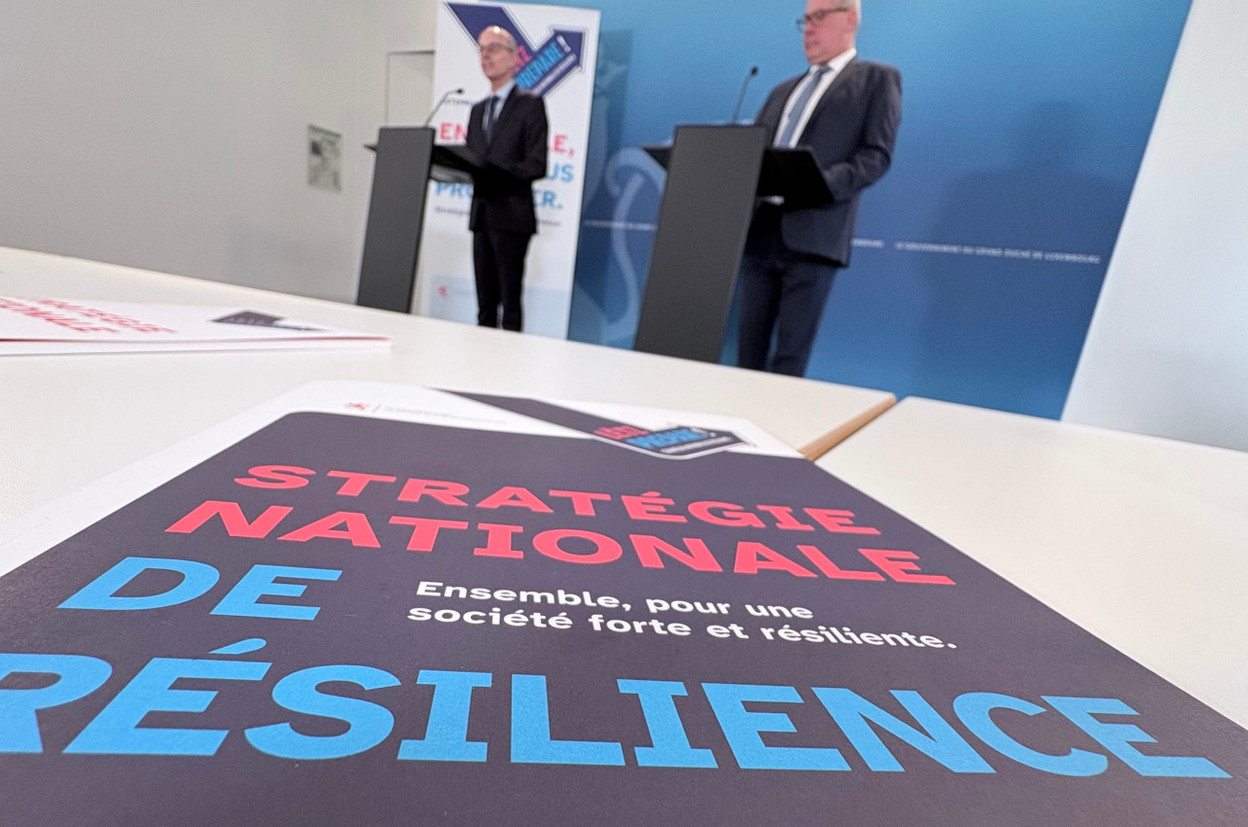
House of Deputies. The Institutions Committee will consider a series of amendments to Bill 8307 aimed at increasing the level of resilience of essential service providers that guarantee vital societal functions and economic activities in Luxembourg. MEPs will then adopt a draft report on a bill 8560 on electronic signatures in legislative and regulatory matters, a prelude to a vote at a forthcoming plenary session.
House of Deputies. The Budget Execution and Finance Committees are continuing their examination of parliamentary dossier 8556 settling the general account for the 2024 financial year. Members of the Mobility and Public Works Committee will also look at this text and carry out financial monitoring of the major infrastructure projects of the Société nationale des chemins de fer luxembourgeois and the Belval Fund.
House of Representatives. The Health and Social Security Committee is examining parliamentary dossier 8606 on the practice and upgrading of certain health professions. This text will establish the profession of genetic counsellor in the Grand Duchy. A draft report will be put to the vote. At the LSAP group's request, MEPs will then debate the deployment of new hospital branches for medical imaging, the creation of medical branches independent of hospital structures and the government's position on private investment in the health sector, in particular the "Findel Clinic" project.
Tuesday 11 November
Court of Justice of the European Union. The CJEU delivers its judgment in case C19/23, which pits Denmark, supported by Sweden, against the European Commission on the validity of the directive on minimum social wages.
Chambre des députés. Members of the National Education, Children and Youth Committee will attend the presentation of Bill 8609. The aim of the text is, in particular, to relax administrative deadlines for organising music lessons and to raise certain teachers' salaries. They will then debate parliamentary dossier 8587 aimed at introducing the "Alpha - zesumme wuessen" reform, which will allow parents to choose, at the end of cycle 1, their child's literacy language - either German or French - on the basis of a professional recommendation. "This educational differentiation aims to establish a fairer start to schooling, while respecting multilingualism - with Lëtzebuergesch at the centre as the language of integration and communication - and social cohesion," reads the explanatory memorandum.
House of Deputies. Continuation by the Committee on Higher Education, Research and Digitisation of Bill 8395A creating the Office of the Government Commissioner for Data Sovereignty.
House of Deputies. The Committee on Media and Communications will be working on the deployment of high-speed communications networks (parliamentary dossier 8318) and the promotion of professional journalism and democratic debate (parliamentary dossier 8421). The latter text plans to introduce a specific right of access to information for professional journalists and to bring the national legal framework into line with the provisions of the Council of Europe's Tromsø Convention on Access to Official Documents, a prelude to its signature by Luxembourg.
Professional organisations. The Idea Foundation presents a working paper analysing the reform of the pensions system tabled by the government this autumn.
Wednesday 12 November
Council of the European Union. Eurogroup meeting in Brussels. On the agenda: macroeconomic and budgetary developments, the competitiveness of the eurozone in a global context, the coordination of budgetary policies within the Eurogroup, the Banking Union and the future of digital finance.
European Commission. The Vice-President of the European Commission, responsible for Technological Sovereignty, Security and Democracy, Henna Virkkunen, presents the Commission's Democrat package. The package includes the European Democracy Shield, which aims to strengthen the Union's resilience in the face of disinformation, foreign interference and hybrid threats, particularly via online platforms and artificial intelligence. Package that also includes the EU strategy to support, protect and empower civil society.
Government. The Employment Development Agency (Adem) and the Ministry of Labour detail the SkillsPlang programme, aimed at facilitating the preventative reskilling and upskilling of employees.
Government. Statec unveils its latest report "Work and Social Cohesion", the central theme of which is the challenge of an ageing population.
House of Deputies. The Labour Committee is considering Bill 8471 from the LSAP political group, which would introduce special leave for blood donors. This would involve a 4-hour exemption from work with no loss of pay and based on a certificate drawn up by the Blood Transfusion Centre after the donation. MEPs will also discuss the conduct and content of bipartite meetings as part of social dialogue at the request of the LSAP political group.
Chambre des députés. The Defence Committee continues its examination of Bills 8068 (compensation and operational compensation scheme for the Luxembourg army) and 8604 (GovSat-2 satellite project).
Thursday 13 November
Council of the European Union. Meeting of the Economic and Financial Affairs Council in Brussels. On the agenda are the revision of the energy taxation directive, the abolition of the duty-free threshold and the European budget.
European Parliament. Plenary vote on the Omnibus I directive.
Members' Chamber. Members of the Mobility and Public Works Committee will be looking at major infrastructure projects, with a particular focus on projects involving the CFL, Public Buildings, Roads and Bridges, as well as the Belval Fund.
House of Deputies. On the agenda of the Economic Affairs Committee is the presentation of Bill 8475, which aims to unify the legal framework for state aid to businesses and to digitalise procedures in this area. MEPs will be working on parliamentary dossiers 8463 (pre-financing of photovoltaic solar installations) and 8386 (renewal of the environmental and climate protection aid scheme).
House of Deputies. Consideration, by the Justice Committee, of two bills from the political sensibility déi Gréng. Bill 8639 is intended to limit the length of pre-trial detention, which is not currently defined. The proposed ceilings are 4 months for simple misdemeanours and two years for serious offences, with certain possibilities for extension. Bill 8643 aims to provide better protection for children in cases of sexual and physical violence committed by a parent. In particular, it provides for the withdrawal of parental authority from a parent who is guilty of sexual violence, even if the victims are not his or her own children. The MPs will also be working on Bill 8550, which ratifies into Luxembourg law the 2019 Hague Convention on the Recognition of Foreign Judgments in Civil and Commercial Matters. The aim of the convention is to strengthen cross-border legal certainty.
House of Deputies. Examination, by the Committee on Agriculture, Food and Viticulture, of Bill 8648 transposing a European directive to better inform consumers about the sustainability of products, for example their lifespan, in particular by introducing a harmonised label and a "reparability" index. One of the aims is to combat the premature obsolescence of goods.
Trade organisation. The Chamber of Trades presents its opinion on the draft 2026 budget.
Friday 14 November
Council of the European Union. </Meeting in Brussels of the Economic and Financial Affairs Council in its budget configuration. On the agenda is the preparation of the meeting of the Conciliation Committee on the EU budget, which will be held on the same day, with the aim of reaching an agreement on the EU's annual budget for 2026.
Chambre des députés. Holding of the 20the edition of the "Jugendkonvent", the Youth Convention. Participants will discuss topical issues of particular importance to them in four thematic workshops on the future of democracy, action in democracy, democracy at school and democracy and inclusion. At the end of the workshops, the young people will present their findings in the plenary room and exchange views with political representatives.
Members' Chamber. The MEPs on the Finance Committee will be looking at bills 8628 (arrangements for delegation, liquidity risk management and declarations for supervisory purposes for alternative investment funds), 8591 (arrangements for implementing OECD Pillar Two, in other words the 15% minimum effective taxation of large companies) and 8529 (transposition of the DAC 8 directive aimed at providing a better framework for the taxation of cryptoactives and increasing the transparency of digital transactions).