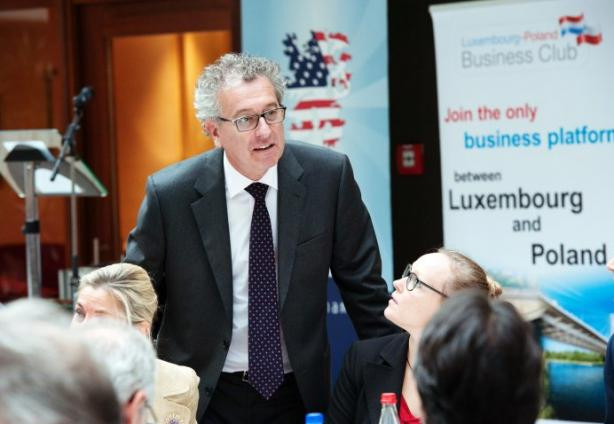
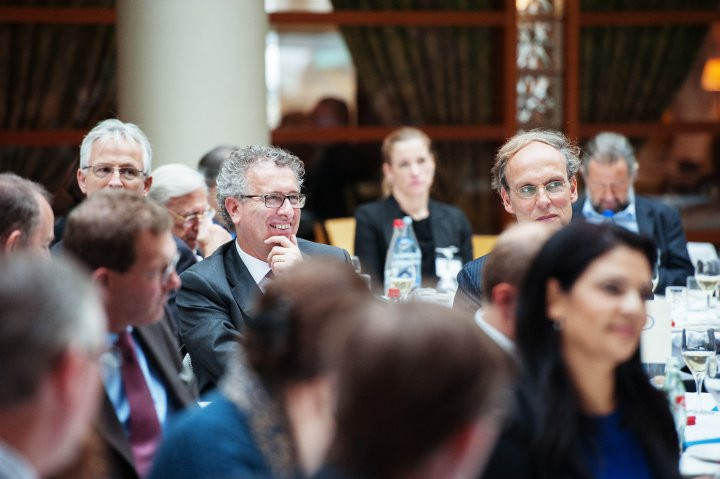
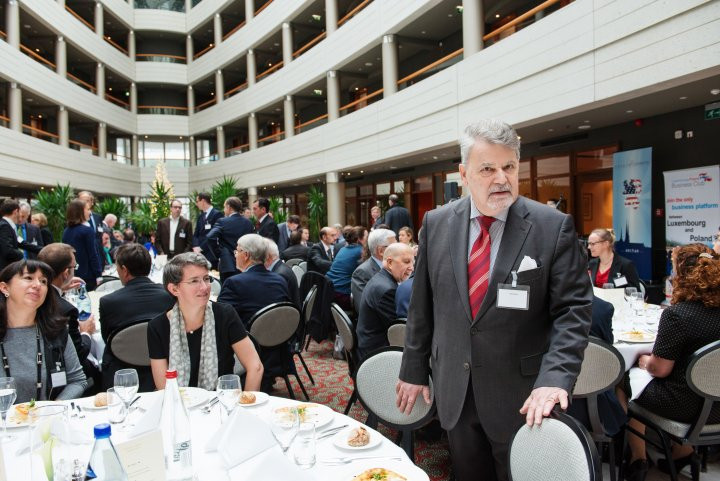
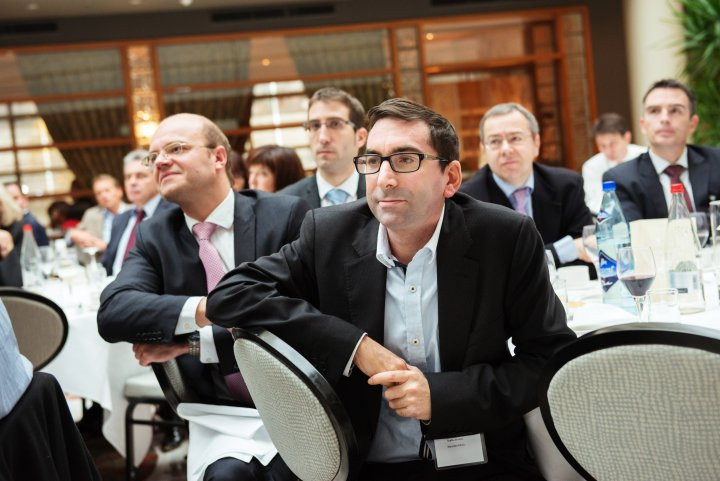
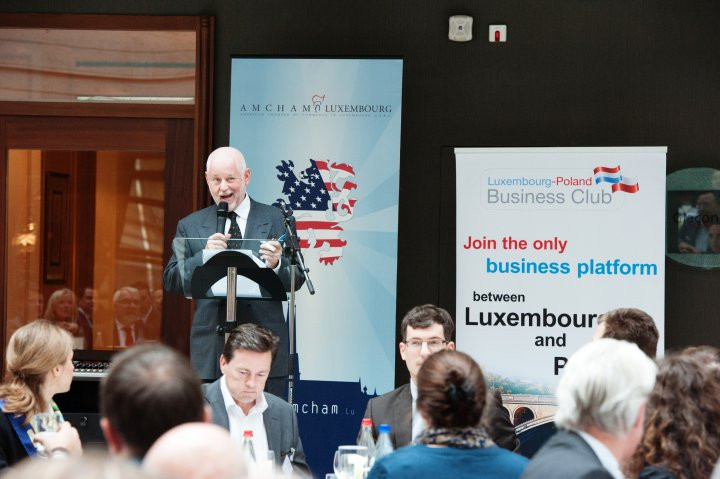
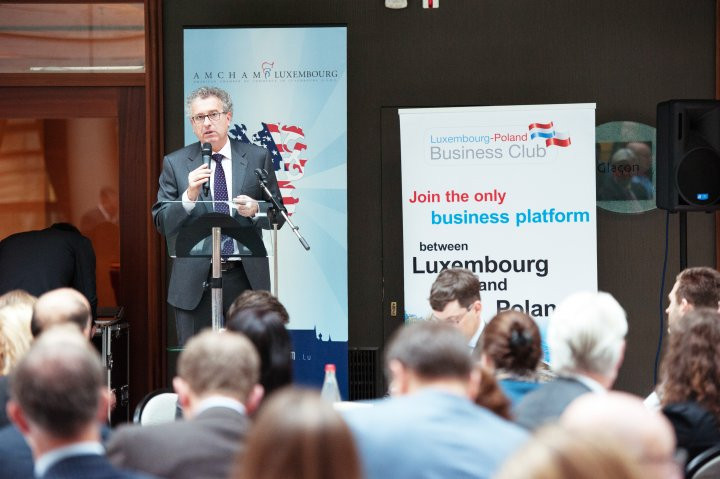
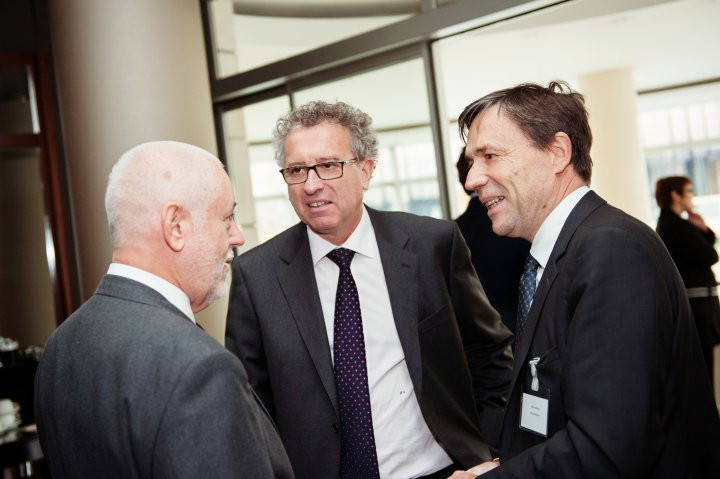
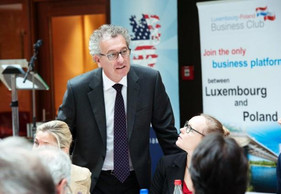
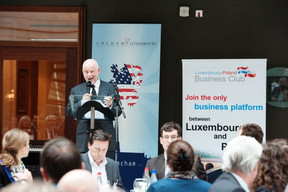
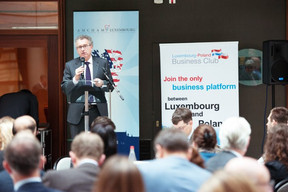


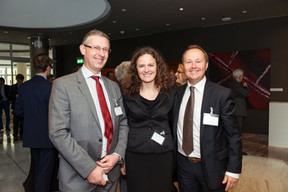

Despite tackling topics such as budget reforms, taxation, transparency and the LuxLeaks affair, it was a smooth-talking finance minister who addressed the international business community Tuesday.
At an event hosted by the American Chamber of Commerce in Luxembourg (Amcham) with the Dutch Trade Forum (NHF), Ireland Luxembourg Chamber of Commerce (ILCC) and Luxembourg-Poland Business Club (LPBC), Pierre Gramegna defended the government’s savings package, which includes a new 0.5% “contribution” on all revenues (intended for childcare) and a 2% VAT increase in the “standard” and “intermediate” rates.
“Nobody likes it, but everyone has to make an effort,” he stated, underlining that considering the world we live in it remained “a small effort”. At the same time, he also confirmed that companies would not see an increase in their taxes for the next four years. They will however be “more scrutinised” when asking for support for employee training for example.
Labour unions are asking for one-year moratorium on the 0.5% contribution but the minister made it clear that while the demand had been “acknowledged”, a postponement was not on the agenda. “The contribution is part of package. We can discuss what to call it and in which ways the money should be used, but we can’t take it out. Otherwise we will not be able to balance the budget by 2018, which is our goal.”
Gramegna nevertheless admitted that it was only the “second best solution”, the best one being a modernisation of Luxembourg’s tax system. “But a fiscal reform takes time and we don’t have enough now,” he said, all while stating that a reform was underway.
VAT changes
As for the 2% increase in VAT, which will take the standard rate up to 17% in January 2015, Gramegna remarked that it remained the lowest in the EU and that government will still retain the special low rate on essential goods and services at 3%.
The VAT increase will not only contribute to reduce deficit but also to help cope with the loss of VAT receipt linked to the changes of rules applicable to e-commerce services. “Next year, we will lose €700-800 million because of the change in the VAT regime on e-commerce,” the minister pointed out.
Public debt
Luxembourg’s public debt represents a little over 23% of GDP today. By international comparison this is low, but for Luxembourg, it’s too high and evolving in the wrong direction, according to Gramegna, who aims to bring the central government’s budget deficit down to zero by 2018.
However, the lack of balanced budget did not prevent the minister from showing his satisfaction with the return to a 3% growth rate this year and an estimated 2.5 % next year, largely thanks to the financial sector.
Talking further about the financial sector, he stated: “We are living in a changing world and we are embarking on a ship of transparency.” In the current situation where transparency will be generalised, “Luxembourg is no longer reluctant” to be compliant, he said, adding that the Grand Duchy was even one of the early adopters of the OECD’s Common Reporting Standard.
LuxLeaks: “we are part of the world”
It was of course impossible for Gramegna not to mention the LuxLeaks affair, though he did not deviate from the official statements. The minister called it “an attack on a country”, recalling once again that other countries used the same system. He affirmed Luxembourg would continue to do rulings as “they are legal and not secret” and keep being attractive to foreign companies, though a shift “from quantity to quality” might be necessary.
“The cases of companies that pay little or no taxes is of course unacceptable”, he said. “But Luxembourg cannot solve the problem alone and it is not enough to act within the EU. It must be done on a world level. We are committed, ready to cooperate and we want to find solutions. We are not doing anything against the rest of the world, we are part of the world.”
Gramegna closed the LuxLeaks chapter by remarking that “luckily no foreign governments has attacked Luxembourg.” Maybe because they know, as he also joked, that a country whose national anthem mentions wine in the first lines, “can’t be all that bad”--though most people here would probably prefer that the VAT on that wine remained at 15%.