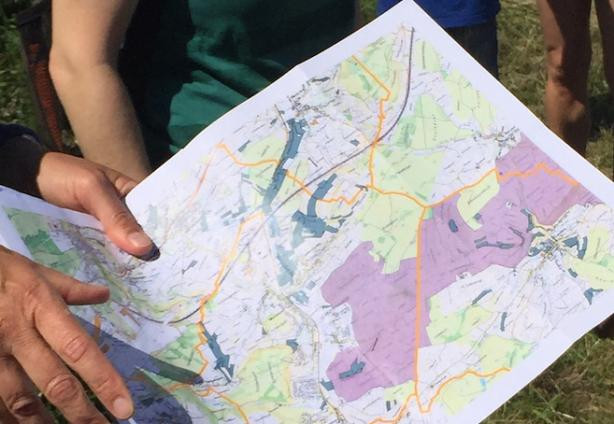
Just got back from a three-hour biodiversity walk near Munsbach, collapsed on the sofa, moaned and groaned a bit. Hay fever and nature hikes are never the best of bedfellows, and today was no exception. Lovely weather and countryside might bring out the best in people and make for great photos, but it also tends to bring out a lot of pollen, and my respiratory system was not amused.
Fortunately, I did not need to think about allergies much during the walk itself, as the infotainment level was consistently high, thanks to our very knowledgeable guide, Doris Bauer of the Biologische Station - Naturzenter SIAS. I already know quite a bit about the environment, but they are mostly loose details; she helped connect some very important dots and fill in gaps.
I already knew, for example, that a lot of the water we drink comes from aquifers that store the water that seeps through sandstone layers, and that this is because sandstone works as a natural filter, clearing out all kinds of impurities. I also knew that sandstone does not filter out dissolved chemicals like pesticides.
What I did not know was that farmers may choose to grow crops on the poor soil that you get when (as a result of natural process of weathering) sandstone reverts to sand, because sandy soil is easier to till than clay-rich soils, even during rainy seasons (no shortage of that here), while clayey soils are very difficult when they are wet. Of course, sand does not have much to offer plants in terms of nutrients, so farmers add fertilizer.
Of course a lot of that fertilizer, and any pesticides added later, gets washed away and quickly finds its way into the aquifer every time it rains, but it still makes economic sense for the farmers to work this way. Now it is very difficult to blame the farmer for choosing a solution that keeps his or her business afloat and ultimately his or her family alive; it is up to us to make sure that long-term solutions for all of us also make economic sense for the individual in the short term.
The EU is obviously playing a part in this, by setting up large scale projects and strategies to protect what we can, from habitats and biodiversity in general to certain key and/or endangered species. But you find these kinds of initiatives at all kinds of levels. Natur&ëmwelt, the main Luxembourgish nature and environmental protection NGO, is active on the national level, but there are also regional and local initiatives. The municipalities of Betzdorf, Contern, Frisange, Junglinster, Niederanven, Sandweiler, Schutttrange and Weiler-la-Tour tackle several environmental issues together in the The Syndicat intercommunal à vocation multiple or SIAS.
Biodiversity contracts
One of the things they do is try to convince farmers to sign a “biodiversity contract”, which among others means cutting the grass in their fields later than usual, which is good for the insects and the birds that feed on them. Doris explained this while we were all standing on one of the few unpaved farm lanes left in the area, typically home to the type of insects that feed the grey partridge, once a common bird, but now greatly diminished in numbers, because the roads are being covered in asphalt to accommodate the heavy farm machinery.
A little further along the way, she pointed out how those of us with a garden can even make a small contribution to maintaining biodiversity ourselves, by letting certain parts of our gardens go/grow wild, and by making sure that we have more than just a lawn. Having a large variety of plants is essential for maintaining the diversity of insects and of certain key insects like the bee, which I had to mention specifically because this walk was organised by Bee Together, and I need to thank them for doing so.
It was a lovely and very informative walk and I met a lot of nice people, and I even got a tip on alleviating the worst allergy symptoms. Going to try that one out now... (moan, sneeze, groan).
If you are interested in activities and events related to nature and the environment, you can join natur&ëmwelt English-speaking Section’s mailing list here.
If you are interested in activities and events related to bees, beekeeping, pollinators and biodiversity, you can join Bee Together's mailing list here.