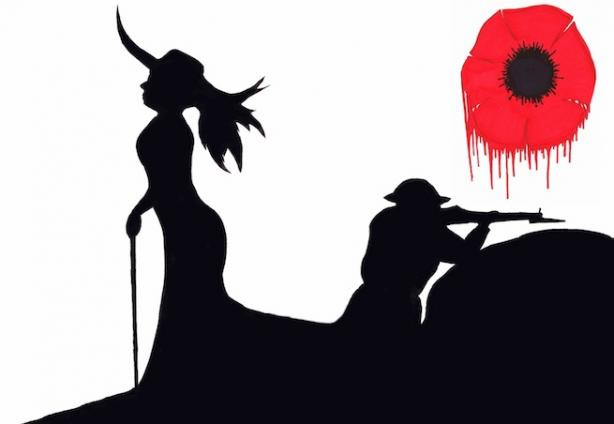
Oh! What a Lovely War, the blockbusting 1963 musical about World War I, brought to Luxembourg by the New World Theatre Club, is a worthy and winning revival. With an adept cast of 29 and a backstage crew of 40, it takes a place among past NWTC triumphs.
We are welcomed to the summer of 1914 with news that the Austrian archduke and his wife have been assassinated. It means war, but never mind. No one cares. No one cares all through Act One while casualties mount and the generals begin trading the lives of tens of thousands of soldiers for a thousand yards of enemy territory--soon to be lost back to enemy counterattack.
Meanwhile, back in Blighty, a music hall star sings:
On Saturday I’m willing
If you’ll only take the (King’s) shilling
To make a man of you.
A soldiers’ version (not part of the present production) goes:
Monday I touched her on the ankle...
and advances relentlessly through the week.
But if the play’s opening is lighthearted and its songs full of cheer (Pack Up Your Troubles), the tune called by Act II is devastation and death.
“Oh! What a Lovely War,” wrote historian A.J.P. Taylor, “does what the historians failed to do: it tells what World War I was all about.”
It tells that Field Marshal Douglas Haig, commander of the British Expeditionary Force, prayed: “I ask thee, Lord, for victory--before the Americans come.” That strikes precisely the right note because it happens to be precisely what Haig said.
Oh! What a Lovely War was conceived by Joan Littlewood, a rebellious theatre genius of the ‘60s. It is said that she hated the colour of khaki, in all its shades, a problem when costuming a play about soldiers. Arguments ensued, to be resolved with the canny idea of dressing the cast in the versatile costume of Pierrot, the stock character of pantomime and Commedia del’Arte. Throw a ragtag jacket over someone’s shoulders and he’s a soldier. Pierrot was taken over by the NWTC production, as were the original’s imaginative use of space and lighting.
The play comes to Luxembourg after seven years of planning and plain hard work by its leading proponents here, director Julie Fraser, producer David Mittel, and NWTC chairman Christopher Albrecht. There are no stars in this production; the actors play multiple roles, one as many as seven--soldiers, suffragettes, politicians, profiteers, top brass, plain Tommies. Some are outstanding; without exception, all are utterly believable. One chats up the audience to start things off, demolishing the gap between stage and spectators; later he reappears as a drill sergeant in what the Guardian once called “a hilariously unintelligible training exercise.”
There is a kind of magic woven by the words and the music, by the way a scattering of men with broomstick rifles on a bare stage win you over to accept them as an army. Periodically an imperative telegraph signal disrupts the scene, announcing still more catastrophic casualty figures; these are read out from a newspaper by varying cast members (sometimes with less than the attention-commanding intensity such brutal news calls for; in the original production, the figures were posted on a running ticker tape above the stage).
The songs now go from heartfelt (Keep the Home Fires Burning) to rebellious (I Don’t Want to Be a Soldier), and the play comes to its inconsolable end.