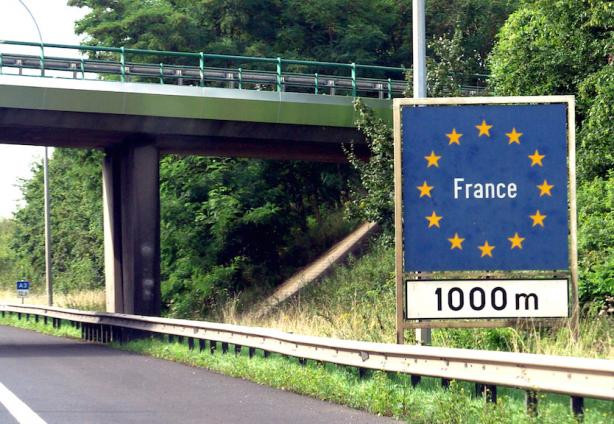
If the road and weather were clear, this trip would take 45 minutes.
We leave Bonnevoie at 6:45 p.m.
During the workweek there’s always a traffic jam headed south, but now there are even more bumps in the road. In the wake of the 13 November Paris terror attacks, France introduced “border checks”. They are meant to be temporary, however European politicians from the 2017 French presidential election frontrunner to the current prime minister of Hungary have called for the permanent abolition of the Schengen passport-free travel area. What would ongoing border controls cost the Grand Duchy?
It is “hard quantifying” the potential impact on Luxembourg’s economy, as no studies have been done on that specific question, notes Sarah Mellouet, an economist with the Idea Foundation, the Luxembourg Chamber of Commerce’s think-tank. Yet the stakes are high.
7:45 p.m.: totally stuck on the A3 motorway. Back-to-back parked lorries line the emergency band.
Nearly half of this country’s labour force are cross-border commuters, and French residents represent 23% of all active workers here, according to Statec, the national statistics bureau. On average commuters spend 17% of their gross income inside Luxembourg, about €925m each year, reports the Luxembourg Central Bank. Plus 45% of all tourists in Luxembourg are inhabitants of the three neighbouring countries, says Statec.
About 90% of French commuters travel by car, Mellouet points out. (Extra train service was laid on that can carry about 3% of total French commuters.) She predicts that, “if controls were to be held on a daily basis, it would have a real impact” on the economy, simply because staff would be increasingly tired and stressed out, not to mention continually late to the office. Following the attacks, there was a spike in sick leave, for example.
We creep past the frontier around 8:45 p.m. and pass the first motorway exit inside of France (the one that leads to Cattenom) at 9 p.m.
Others downplay the threat, saying workers will adapt. Due to lost work time, there could “be a decrease in production,” says Statec’s chief economist, Ferdy Adam. But then there could be “a, slight, increase in hourly productivity” (as coffee breaks are skipped, presumably). If the checks continue, “I think one can assume that it could have a measurable impact on quarterly GDP, but would it be big, or larger than normal fluctuations? I would rather think that it would disappear in the normal fluctuations.”
Two lanes slowly merge into one. Finally at 9:25 p.m. we drive past a pair of police officers watching traffic drive by. We whiz by Thionville a few minutes later.
“For many of the cross-border commuters,” reckons Darren Robinson, managing director of the recruitment firm Badenoch & Clark in Luxembourg, “there are no other options for them than to continue to commute or relocate to Luxembourg or another city”.
Arrival in the centre of Metz: 9:45 p.m.