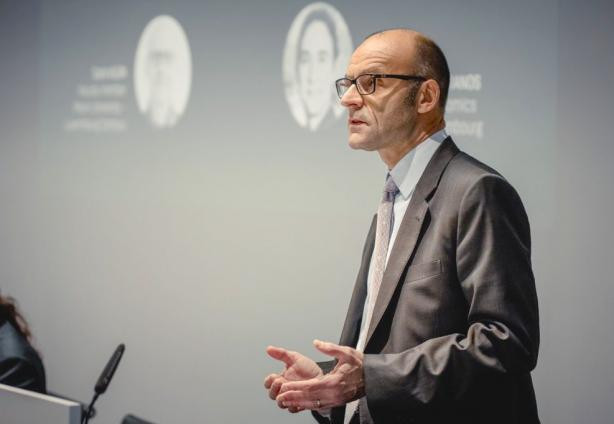
Having recently taken part in a debate, together with my partner, Marc Wagener, I had the opportunity to defend John Maynard Keynes’s theory about the fact that total spending should be increased during recessions to improve the level of employment in an economy.
The interesting fact about that debate was that our team, Marc and I, were referring to the theoretical arguments presented by Keynes in his different writings, whereas our opponents mainly referred to the consequences of an inappropriate policy application of this theory.
At the end of the debate the majority of the audience was still convinced that Keynes was right, but a certain number of listeners changed their mind following our opponents’ arguments that a badly or wrongly applied theory leads to even more problems, like unsustainable sovereign debt for example, than those the economy was facing initially, like a high level of unemployment for example.
Now who is right? Both sides were right in a certain way. If there is a strong recession, private spending due to uncertainty is insufficient to “kick start” the economy and there is definitely a need for public intervention.
On the other hand this public intervention has to be organised in a way that this spending not just increases present demand, but also allows a country or a whole area, if we think about the euro zone, to adjust and develop its economy while taking into account its structural challenges. Then, during the following boom, not during the end of the recession, politicians need the courage to reduce public spending and leave the economy mainly up to the private market.
Half-Keynesian policies?
So who’s to blame? Keynes who was probably overconfident that enlightened politicians would apply his theory and would apply all of it, not just the parts that are “voter friendly”? Or rather the politicians themselves who just pick from different theories those elements that will satisfy their voters without considering the overall economic consequences?
This brings us to the real challenge that we are facing: how can we develop (new) theories in social sciences (because this is not just a problem in economics) that will be understood and accepted by our society and that will be applied correctly by politicians? I have to admit that I have no answer to that question, but I think it is worth that the future generations of social scientists and of course economists consider this crucial aspect of scientific research.
We simply cannot imagine a society without any public intervention based on well-developed theories. Therefore I will leave the last words to Keynes himself: “… the ideas of economists and political philosophers, both when they are right and when they are wrong, are more powerful than is commonly understood. Indeed the world is ruled by little else. Practical men, who believe themselves to be quite exempt from any intellectual influences, are usually the slaves of some defunct economist.”
Carlo Klein teaches economics and social sciences at the Athénée de Luxembourg and international economics at Miami University in Differdange.