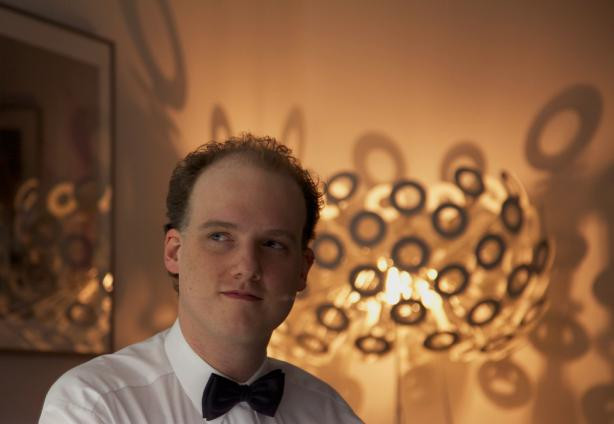
One of Luxembourg’s best known musicians abroad, pianist Jean Muller, is releasing a new album, “Transcendence”, on March 15. Delano caught up with Muller following his February 24 performance in the Philharmonie’s grand auditorium, which featured several works by Franz Liszt.
AG: What inspires you as a musician?
JM: “What has inspired me in the past and what continues to inspire me today is continually changing, as I find myself changing as an individual and then as an artist. What might have affected me deeply ten years ago might no longer hold currency today, but what continues to be the wellspring of creativity and insight for me is what remains most constant: life itself.
“Life is my inspiration and even though the parameters by which I assess it might move or be altered by my experiences, such as becoming a father, or a teacher, say, but the subject matter remains a constant. Life is my inspiration to make music, and I have never found any better way to deal with the multiple challenges of every-day life, than expressing myself through music.
“It is a simple but exciting phenomenon: whilst I am inspired by every-day life, it is actually the making of music that ultimately drives me to want to make more music. The more projects I complete, the greater is my appetite for the next challenge.
“This also bears comment on my life as a whole, outside of music: living makes me want to live more. One could always get more philosophical about it, perhaps fill it with abstractions, because a musician’s relationship to music is likely as individual as his relationship to his own life, but even with that weight of complexity to it, I should say this has never diminished my appetite for music or for living.”
AG: What attracts you to Liszt's work?
JM: “Liszt as a person is already an absolutely fascinating subject, a figure who was as drawn to the diabolical as he was to the divine, with a permanent curiosity about people coupled with an immense generosity.
“Liszt had been a teacher and as such taught many generations of great pianists and never asked for a dime from any of them. He helped Wagner to make his breakthrough and encouraged countless composers to follow their artistic vision, whilst fully helping to promote works of past composers like Schubert--which would have been tragically lost were it not for Liszt’s intervention and promotion.
“All this would already be enough to make him one of the most fascinating figures of the 19th century music history, but on top of that he invented the piano recital as an art form, revolutionized the entire field of pianism by imagining and virtually creating every technical subtlety still in use to this very day, and writing music for the piano that seems to overcome the limitations of the instrument in a visionary and orchestral manner.
“So, in conclusion, in spite of all the difficulties and virtuosic challenges his music contains, he was at heart a true poet.”
AG: Is there a special thrill playing at the Philharmonie?
JM: “The Philharmonie is considered to be the temple of music here in Luxembourg. The sheer size of the grand auditorium is impressive, whilst being perfectly suited for Liszt’s orchestral pianism.
“As a Luxembourger it certainly is a special thrill to perform at the Philharmonie, because it is the most distinguished venue for classical music in this country, and the audience in particular is in some percentage made of acquaintances!
“This gives my performance a certain warmth in its predisposition to the faces in the crowd, so to speak, and certainly adds to the great joy of playing in that spectacular venue.”
Muller performs at the Salle Cortot in Paris on March 17, Cube 521 in Marnach on April 6, and at the Alte Oper in Frankfurt on April 13.