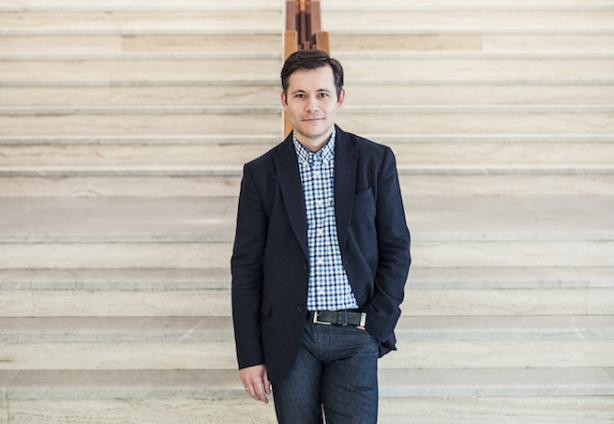
Talk about a hard act to follow. Tom Leick-Burns is the first to acknowledge the achievements of the man he is going to succeed this summer as the director of the Luxembourg City theatres. Frank Feitler is acclaimed for having turned around the fortunes of the Grand Théâtre (which together with the Théâtre des Capucins is owned by the Ville de Luxembourg) and Leick wants to carry on that good work.
He has, after all, worked with the outgoing director for over ten years. “I see Frank as a mentor. When you have someone who changes your trajectory in life like he has mine, that’s very special,” he explains.
It was Leick’s English connections--he trained as an actor in London--that gave him his first break on the administration team at the theatre. In 2004 Feitler roped him in to help with a production directed by Robert Wilson and that collaboration continued when Leick worked as production assistant for the Barbican’s visiting performance of Julius Caesar starring Ralph Fiennes. By 2008 he was given a permanent contract.
From Feitler, Leick says he learned that the job is all about spending time with artists, giving support and help, which could be financial or simply in the form of providing a rehearsal space. “That is the way to develop relationships that last,” says Leick.
“Showing an interest and a love for people in the field we are in, whether it’s an actor, director, choreographer. That ability to get into someone’s mind and detect the spirit and quality of a project and than being able to say, ‘yes, let’s go for it!’.”
Leick says his first approach will be to maintain the level of international co-productions the theatre has managed to attract over the past decade or so. He is speaking exactly one week before the world premier at the Grand Théâtre of Ivo van Hove’s Antigone--a co-production with the Barbican in London--starring Juliette Binoche. “Even by Frank’s standards, that was quite a coup to pull off,” says Leick admiringly.
Multilingual programming
The continuity that the appointment of Leick gives to the theatres is important. “I want to carry on the vision that Frank had. Because to have someone come in from the outside and start from scratch with their vision, it would have broken my heart. I would have found it difficult to stay, knowing the love and time and sweat that has been invested.”
He may have an innate love of British theatre, which he says is the best in the world, but Leick is fully aware of his responsibility to the audience. “Luxembourg being the complex, multinational, multilingual place that it is. That is who we are programming for.”
Nevertheless, he says he will cherish and develop relationships with partners in the UK. “There are some very interesting projects in the pipeline for the 2015-16 season, which I cannot go into yet.” But with no support for tours from the Arts Council in the UK, companies have to pay for their own tour, which makes it expensive and difficult to sustain financially. “I think the Arts Council is starting to realise that the work done abroad by companies like Cheek By Jowl feeds back into the work they do at home. I am constantly working to bring new companies over. That’s the fun part of the job, if I’m completely honest.”
Now armed with an MBA in management, which he says gave him a new sets of skills and confidence, Leick will be in charge of a team of 70 and also has ideas for encouraging and developing local talent. “I specifically chose an MBA and not a degree tailored to the arts or the theatre. I applied it to my environment, which is a very useful exercise in itself.”
Encouraging youth
While much of the focus is on the Grand Théâtre, since recently deceased former director Marc Olinger retired as head of the Capucins theatre in 2010, Feitler has been in charge of both city theatres. For Leick the Capucins remains a special place, where he started as an actor, and it represents an opportunity.
“I would love the Capucins to be the theatre that speaks for Luxembourg creation, a platform for emerging talent to try out things without pressure to deliver a product--where it can mature under the guidelines of established and older artists.”
For instance, he would love to see visiting artists at the Grand Théâtre give workshops or master classes for local talent at the Capucins. “If we have the ability to continue financing international co-productions, I think one of the criteria I will use is that I want something to happen in Luxembourg to justify that.”
As for the longer-term future, Leick is optimistic about the prospects for Luxembourg theatre. “The fact that we are now building sets for international productions that go on tour is amazing, showcasing local talent. It says a lot about the level of professional theatre in Luxembourg.”
He would love youngsters to enjoy the experience of studying abroad as he did, but he would also like to give them an opportunity to find work when they return to Luxembourg. “As the biggest employer in the field, we have to play an active role while maintaining a quality programme. I want young people to realize they can have a career in theatre.”