The European Central Bank “will do all that is needed for the euro to have a long and prosperous life” although there are limits to what monetary policy can accomplish for the economy, Yves Mersch said on Monday evening.
The member of the ECB’s executive council also argued in favour of the EU-wide banking regulatory and bank resolution schemes, currently being debated in European capitals, during a speech in Luxembourg evening marking the central bank’s anniversary.
The ECB should be mandated with supervising “a fully-fledged banking union, as complement to monetary union [that] supports financial integration and monetary policy transmission and hence ultimately reduces the burden on monetary policy,” contended Mersch, who was speaking as part of the Luxembourg Stock Exchange’s annual “Stock Exchange Day” conference.
In fact, the “banking union was a missing element in the original Maastricht design. It is essential to provide a durable foundation for monetary and financial stability and to ensure a level playing field”, according to a transcript of Mersch’s remarks provided by the ECB.
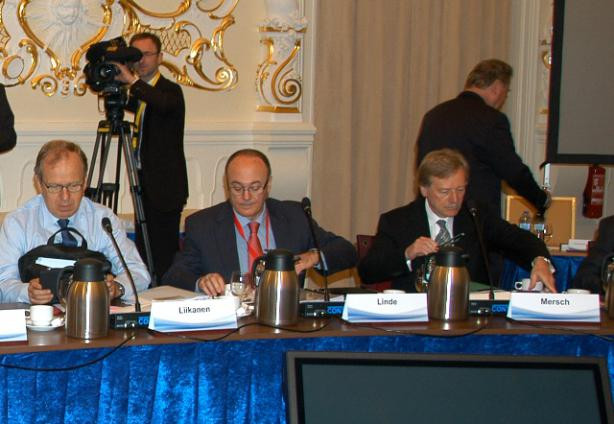
While many in Europe’s financial sector have maintained that the central bank does not have the staff and expertise to take on the extra roles, “swift implementation of” an EU-wide banking regulator and bank resolution scheme “would reduce, not increase, the risks of overburdening monetary policy”, Mersch (photo, far right) said.
Limits to monetary policy
At the same time, he indirectly alluded to the need for European political leaders to take painful decisions. “Monetary policy measures in a crisis can serve a critical role in guarding against disorderly self-fulfilling disruptions. They can buy time for other policy domains to undertake the necessary adjustments and reforms. But they cannot substitute for such actions. They must also be mindful of adverse longer-term consequences of short-term support provided.”
Reflecting on the euro’s 15th birthday this month, Mersch remarked that: “in the crisis the euro area had to grow up very quickly amidst daunting challenges to its identity, even its very existence. Further turbulence cannot be ruled out.” But he reckoned that: “the euro will stand on solid feet and emerge stronger, provided that all in the family of stakeholders live up to their respective responsibilities.”
Mersch commented that the anniversary of the ECB, which began operations in May 1998 in Frankfurt, “is passing almost unnoticed”. However, he concluded that “the ECB, for its part, has delivered on what it has been asked to do.”
Mersch was both head of the Banque centrale du Luxembourg and member of the ECB’s policy-setting governing council starting in 1998, before joining the ECB’s day-to-day management board last December.