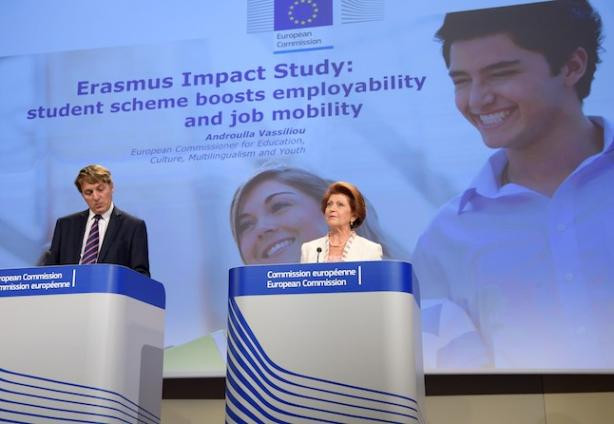
Youngsters who participated in an EU educational exchange scheme are much more employable, a report commissioned by the European Commission has found.
The 27 year old Erasmus programme allows students in higher education to study or train in another European nation, with the experience recognised by their home institution. Around 250,000 students did so during the 2011-12 academic year, according to Eurostat, the EU’s statistics agency.
On Monday, the commission released its study on the scheme’s effectiveness, with more than 85% of students who participated stating their stint abroad “enhanced their employability”. The study also found that Erasmus alumni needed half as long to find their first position, and that five years after graduation the unemployment rate for Erasmus students was 23% lower than non-participants.
Indeed, the commission noted that: “more than one in three Erasmus trainees were offered a position at their host company.”
“The message is clear: if you study or train abroad, you are more likely to increase your job prospects,” European education commissioner Androulla Vassiliou said in a press statement.
In addition, the study found that 64% of European employers considered international experience important, up from 37% in 2006, and 64% of bosses reported giving “graduates with an international background… greater professional responsibility”.
International relations
The authors touched on the more personal impact of participating in the programme: one in three former Erasmus students “have a life partner with a different nationality” and “27% met their life partner during their stay abroad”.
The report, “Effects of mobility on the skills and employability of students and the internationalisation of higher education institutions (PDF)”, involved surveys of roughly 80,000 current and former students and businesses in 34 European countries, and was led by the German research outfit CHE Consult.