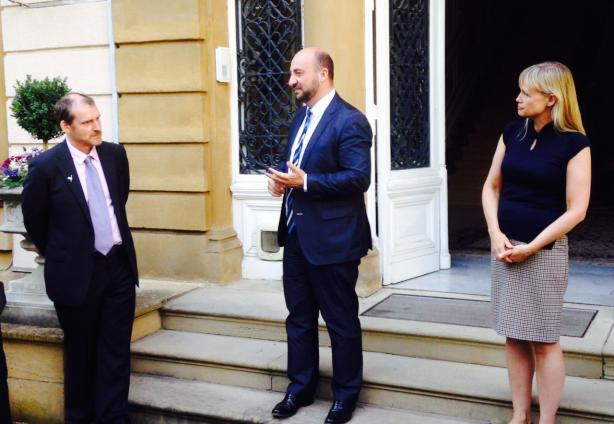
British ambassador Alice Walpole was “proud and excited” to host a reception on Wednesday celebrating the collaboration between Oxford Space Systems--a small British enterprise specialising in deployable structures for the space industry--and LuxSpace--a Luxembourg company specializing in satellite production.
Walpole said that the cooperation agreement shows what small, British companies can do when they “put their mind to it”. The agreement between LuxSpace and Oxford Space Systems was signed that morning. Another contract, between the European Space Agency and LuxSpace should also be signed on the fifteenth of July.
The event was attended by representatives from the Luxembourg space industry, CEO and founder of Oxford Space Systems, Mike Lawton, and even the Luxembourg deputy prime minister and minister of the economy, Etienne Schneider.
Lawton said that Luxspace had approached the British company a little more than a year ago with a request for novel antennae for small satellites. These satellites will then be used for collecting data, the nature of which Lawton said could not yet be revealed.
The British company began the research, resulting in a prototype (presented at the event) twelve months later from a “blank sheet of paper”, which Lawton said is “very quick” in the space industry. During that time, the theoretical study was completed using 3D-printed models and simulating zero gravity.
Prototype
The prototype possesses a special structure whereby when one point moves, the whole body moves. Lawton also stressed that this antennae is “jam proof”, as this is often a problem with antennae structures in space. The satellites created with this antenna could be used for usual data collection such as internet, or other valuable data.
For example, a twelve meter version of the antennae could serve for the measurement of Bio Mass, which would measure the amount of wood on earth, helping collect information about deforestation. The antennae cost between two and three million euros per meter of diameter, Lawton explained, making the Luxspace and ESA deals very lucrative. He also added that this is merely the first of many projects Oxford Space Systems hopes to do in collaboration with LuxSpace.
Ultimately, Lawton’s goal would be for Europe to be put at the front of the space industry. He wishes to do so by using innovative structures and materials, having less complex and less expensive products than his American competitors, who are currently leaders in the industry.
Schneider also came to see the prototype. In the past years, Luxembourg’s government has decided to diversify to different sectors, and the satellite industry is one of the applications selected for expansion. The deputy prime minister said that they are working on that and are delighted when there is such an opportunity to gather people to help their goal. He also said that Luxembourg already enjoys a close relationship with NASA.
In addition, Schneider compared the action of the current government to the one in the eighties, when the government decided to further diversify the economy by encouraging the satellite industry, which proved to be fruitful despite initial skepticism. He added that the government is now going for another “scoop”, which he says could be at least as important as the decision to create SES Astra.