A decade-old Luxembourg satellite firm has marked a milestone in promoting global maritime safety and environmental protection.
LuxSpace said its pair of “Vesselsat satellites have passed a combined four years in orbit.” The first microsatellite was launched in October 2011 and the second two years ago. The duo provide space-based “automated identification system” services to ship operators.
According to the European Maritime Safety Agency, an EU body, AIS data is used to track ship movements and communicate with crewmembers on board. That means that, in addition to aiding navigation, AIS data can be used to help fight piracy and pollution.
LuxSpace’s “two satellites have delivered several billion AIS messages, which are sold to customers on global scale,” the company said in a communiqué on January 22.
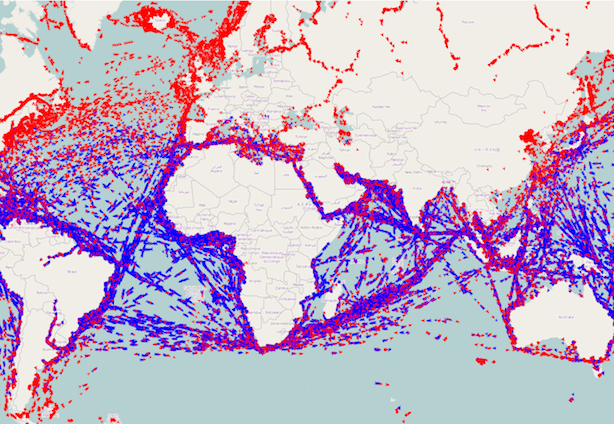
The firm also released several images illustrating the information it provides (shown above).
The first “snapshot shows a 24 hour track record of the global ship traffic around the world,” LuxSpace researcher Dr. Gerd Eiden explained to Delano. “The red dots indicate AIS messages captured by VesselSat1, while the tracks in blue colour are received by VesselSat2.”
“The picture illustrates the main (intercontinental) shipping lanes and areas with a high vessel density (busy sea areas). With the advent of satellite based AIS, a near real time global view of the entire ship traffic becomes possible, allowing near real time tracking of an individual ship or monitoring/surveillance of high sea areas, which was impossible before,” he said in an email conversation.
The second illustrates the position of vessels by ship type. “This detailed information enables monitoring of a particular ship type, e.g., fishing vessels for control and enforcement, tanker fleet for monitoring oil supply, etc.,” Eiden wrote.
Grand Duchy flagged ships
For a landlocked country, “there is quite a number of sea-going vessels flying under the Luxembourg flag (around 250 vessels),” according to the LuxSpace researcher. “The picture shows where these ‘Luxembourg’ vessels are ‘flying’: all over the world and not just along the Mosel.”
LuxSpace, a subsidiary of German satellite and aerospace manufacturer OHB, was founded in 2004 and is based on the SES campus in Betzdorf. The company said it employs roughly 50 staff.