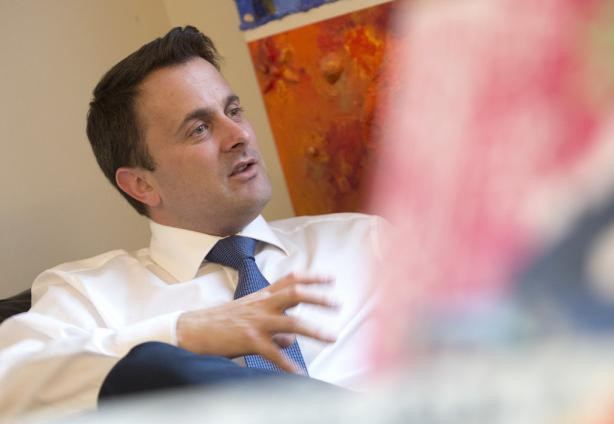
DP prime minister Xavier Bettel is coming under pressure from the CSV opposition over revelations that he had a private meeting with former SREL secret service officer André Kemmer while Bettel was on the parliamentary commission that was investigating illicit surveillance by the SREL.
Bettel told RTL about the meeting on Monday, admitting that he had been called as a witness in October 2015 by the judge investigating the SREL affair to give an account of his meeting with Kemmer. The prime minister said that in December 2012 an intermediary, “a confidant from the police”, had contacted him to set up a meeting with “a member of the SREL” who had information about the SREL.
That person was André Kemmer, who had allegedly supplied the infamous watch with which SREL boss Marco Mille recorded a conversation about the Bommeleeër case with then prime minister Jean-Claude Juncker. The recording of the Mille-Juncker conversation--details of which have never been fully released--and the subsequent findings of the parliamentary commission, led to the resignation of the Juncker government and the early elections that gave Xavier Bettel the premiership.
Manipulated
Bettel has said that he met with Kemmer for around 10 or 15 minutes, but had the feeling that he was being manipulated. It was for that reason, he says, that he subsequently resigned from the parliamentary commission investigating the SREL.
But the CSV has attacked the prime minister’s claims--noting that he only resigned from the commission in April 2013, some four months after the meeting with Kemmer, and that in the meantime he had sat on the commission, including one sessions at which Kemmer was being questioned. Indeed, Bettel is said to have asked Kemmer some 30 questions during that session.
The CSV has said that it was “unacceptable” for a member of a parliamentary commission to meet with a witness in private. Claude Wiseler, the head of the CSV parliamentary faction, said that the information about the meeting raises several questions that urgently need answering. He wants to know whether the commission president, LSAP politician Alex Bodry, or its “reporter” François Bausch were informed of the meeting between Bettel and Kemmer, and whether they knew that this was indeed the reason that Bettel resigned from the commission the following April. “The credibility of the prime minister is at stake,” Wiseler said.
The CSV seems to have the support of the ADR, whose Gast Gibéryen says that the evidence suggests the main aim of the parliamentary commission was to bring down Jean-Claude Juncker, and that the so-called “Gambia” coalition of DP, Greens and LSAP had been formed well before the elections of October 2013.
The LSAP is standing by Bettel. Alex Bodry says he knew nothing of Bettel’s meeting with Kemmer, and suggests that it was a mistake to agree to the meeting, but says that it had no influence on the commission’s findings and that it’s importance should not be exaggerated. And the left-wing Déi Lénk party’s Serge Urbany has attacked the CSV for launching a “political manoeuvre” that he has labelled a “cheap counter-putsch”.