At the European Justice and Home Affairs Council meeting on Thursday, ministers agreed that countries could re-introduce border checks “if a serious threat to public order or domestic security exists” or if another member state fails to stem the flow of illegal migrants entering their external border.
Under the proposed rules, a three month study period would be required before the checks could be re-introduced. Controls could be put in place for six months, with up to three six-month extensions permitted.
Debate over the Schengen zone, which allows people to travel between 26 European nations without passport or customs checks, was ignited by a surge in undocumented migrants following last year’s Arab Spring.
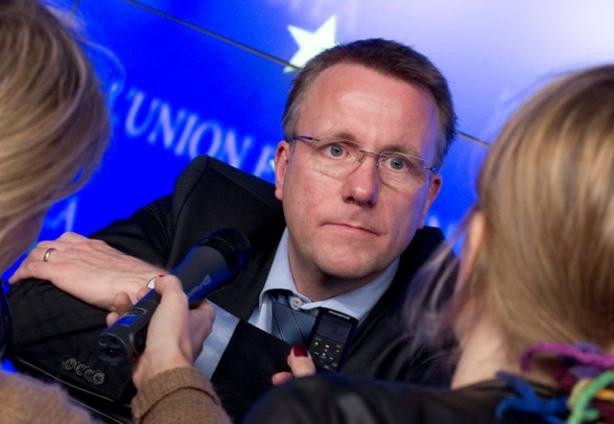
“We decided to introduce a mechanism which ensures swift and decisive action when extraordinary situations threaten Schengen cooperation,” Morten Bødskov, Denmark’s justice minister and chair of the council meeting (photo), said in a statement. “There must be no weak links in the chain when it comes to illegal migration,” Reuters news agency reports him saying at a press conference.
“We are ready to act where citizens’ security is in danger,” Hans-Peter Friedrich, Germany’s interior minister, was quoted as saying by the news agency AP.
Under existing rules, temporary border checks are already permitted under certain conditions. Poland has said it will have controls during the Euro 2012 football tournament this month, as Germany did when it hosted the World Cup in 2006. France briefly instituted controls along its border with Germany when Barack Obama, the US president, attended the 2009 NATO summit in Strasbourg, and along its border with Italy when the G20 summit was held last November in Cannes. Spain had checks when it hosted a meeting of the European Central Bank last year.
The 1985 Schengen Agreement is named after the south-eastern Luxembourg town where it was signed. The free movement zone includes all EU member states except Bulgaria, Cyprus, Ireland, Romania and the UK, plus Iceland, Lichtenstein, Norway and Switzerland.
The council’s new proposal will now go before the European Parliament for approval, where it is expected to face a difficult vote.