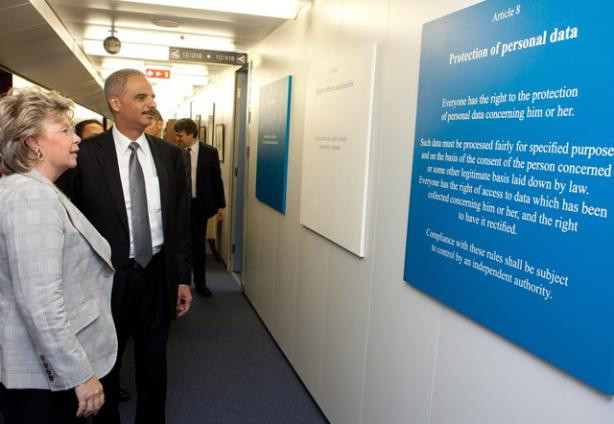
European justice commissioner Viviane Reding has written to the US attorney general expressing “serious concerns” about the electronic surveillance of EU citizens under the American government’s so-called “Prism” programme.
Last week The Guardian and Washington Post published classified documents provided by government contractor Edward Snowden that indicate the US government has accessed and saved telephone and internet data on millions of people, including both Americans living in the US and residents of nearly every country in the world.
The British newspaper said the documents showed the American programme gathered “almost three billion pieces of intelligence from US computer networks over a 30-day period ending in March 2013” and that during the same month the NSA, America’s electronic espionage agency, “collected 97 billion pieces of intelligence from computer networks worldwide”.
The Prism programme allegedly has used data obtained by telecommunications providers and internet firms such as Facebook, Google and Skype, which have been forced to cooperate with the government and restricted from publically commenting on the US government’s practices, according to several UK and US press reports.
“Adverse consequences”
On Monday evening, Reding (photo, left), who is Luxembourg’s EU commissioner, sent a pointed letter to Eric Holder (photo, centre) in Washington.
A spokeswoman for Reding said on Wednesday that the communiqué expressed the commissioner’s “resident concerns about the possible ‘adverse consequences’ on EU citizens’ privacy and stressed that EU citizens have the right to know whether their personal information has been part of intelligence gathering ‘on a large scale’”.
The letter put seven pointed questions to the US attorney general, Delano has learned. Reding asked for “explanations and clarifications” on Prism and any similar intelligence programmes, asking if such initiatives are directed towards EU citizens, and which laws and criteria are applied the processing of the data the spy agency collects.
In addition, the commissioner inquired about the scope of the data collection and search programmes, including how “national security” is defined; how companies in the EU or US can challenge NSA requests; and how EU citizens can be “informed” if they are affected by Prism, and how they can appeal against their personal data being collected under the programme, Delano has ascertained.
The commission spokeswoman said Reding will discuss the matter with Holder during the EU-US ministerial summit in Dublin on Friday, where she hopes to make progress on a data protection agreement between Brussels and Washington that have been under protracted negotiations over the past 18 months.
One sticking point has been the transfer of data to the US under America’s “Patriot Act” which runs afoul of EU rules and the national laws of several member states.
“Controlled by US federal authorities”
A spokeswoman for the US embassy to the Grand Duchy told Delano on Wednesday that it was policy not to comment specifically on intelligence operations or classified matters.
However, she did explain--citing comments made June 7 by US president Barack Obama--that “access to content of the private communication of US citizens and those living in the US is controlled by US federal authorities. In order for any entity in the US to access the content of any private communication within the jurisdiction of the US, a US federal judge must grant permission to access that content on a case by case basis.”
The embassy spokeswoman noted that: “any entity wishing to gain access to content of private communications here in the Grand Duchy would be subject to relevant regulations under the EU and Luxembourg law.”
According to a White House transcript of his speech, Obama also said American intelligence programmes were subject to oversight by both the US judiciary and US congress. He added that in general “nobody is listening to your telephone calls” and the US government would need a judge’s approval in order to read the content of a US citizen or US resident’s email.