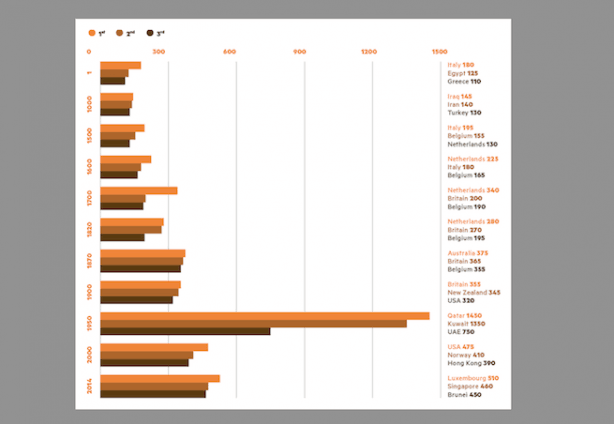
Luxembourg has been part of the great sweeps of history that have affected this continent since Roman times. A quirky graph compiled by The Economist magazine illustrates this by listing the countries with the highest national income (GDP) per head over the last couple of millenniums.
Thanks to Luxembourg’s open, international financial sector, it often ranks in recent years as one of the richest countries in the world. If you add up total economic output and divide it by the number of residents, we’re better off here, on average, than pretty much anywhere else. The Economist did these sums going back to 1 AD using the boundaries of modern countries.
The 999 square miles we now know as Luxembourg has been a prize coveted by empires and states since civilization came to northwestern Europe. It was an easy to defend fortress literally at the crossroads from important towns such as Trier, Arlon and Reims. This enabled rulers to levy taxes and tolls, making it a prized asset for local, regional and European dynasties.
Romans (“Italy” in the graph) completed occupation of these lands in 53 BC under Caesar before they were abandoned in 406 AD. Then, about a thousand years later, the then Duchy of Luxembourg was grouped in states together with important towns such as Bruges, Ghent and Antwerp (currently Belgium), and Amsterdam (now The Netherlands). For several centuries these “Netherlands” formed a hugely lucrative trading hub that were passed from dynasty to dynasty: the Burgundians, the Habsburgs, the Spanish and back to the Habsburgs. The French also held Luxembourg for 13 years until 1697.
After Napoleon, the great powers sought to rebuild the state-system he had destroyed, but there was confusion about what to do with Luxembourg. By 1820 the now Grand Duchy had achieved a degree of independence, albeit under the rule of the Dutch king and garrisoned with Prussian troops.
Although the country had been a part of wealthy empires for much of this time, the population did not see much benefit. Poor quality soil kept the peasant population near destitution. Their misery was added to by the arbitrary rule of absent dynastic rulers. Life was harsh even until the late 19th century, as can be seen by the exodus of up to 70,000 to the US.
Yet the seeds of future wealth had been planted. The increasingly independent Grand Duchy joined the Germanic customs union (Zollverein) in 1842, leading to substantial Prussian investment into the steel industry. By 1870 the country was about to start growing strongly, especially thanks to the advent of the railways and new steelmaking technology.
Steel made the country very wealthy for 100 years, but then finance stepped it up further, pushing Luxembourg (back?) to the very top of the rankings.
Luxembourg’s statics agency, Statec, will release 2014 GDP figures on 1 April.
Graphic produced by Maison Moderne Studio:
World’s richest countries 1 AD-2014 (GDP per person* as % of world average)
*Historical output and population within the boundaries of modern countries at purchasing-power parity
Sources: Angus Maddison; IMF; The Economist