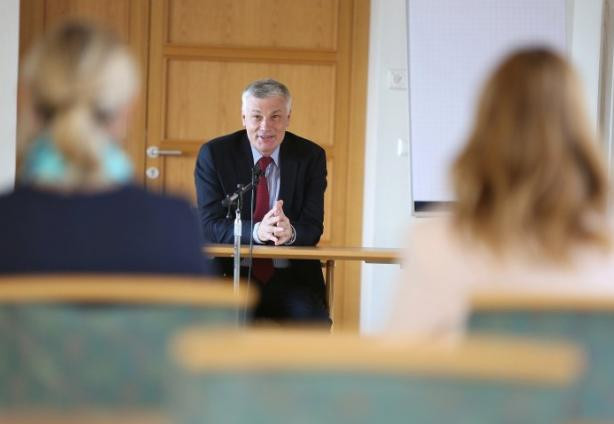
The right to vote should be linked to citizenship but gaining Luxembourg nationality should be made easier, an MP and former cabinet minister has said.
That is one reason why Christian Socialist People’s (CSV) party is campaigning “no” in the national referendum set to take place in less than two months time, Claude Wiseler told a meeting organised by the Danish Church in Luxembourg.
Wiseler is currently president of the CSV bloc in the Chamber of Deputies, and served as infrastructure and sustainable development minister from 2009 to 2013, and public works minister and civil service minister from 2004 to 2009.
He began his speech by explaining why the CSV had voted against the newly proposed referendum. Wiseler emphasised that historically constitutional referendums had only been used in exceptional circumstances which determined the path the country would follow.
Indeed, Luxembourg has only had three constitutional referendums in its history. The first in 1919 to determine the future of the monarchy, the second in 1937 focusing on “freedom of speech” in a time of political extremism within Europe, and the latter in 2005 determining the future of the European Union as it stands today.
The CSV felt that the questions that will be proposed on 7 June were not specific enough to merit a fourth constitutional referendum; specifically the questions relating to voting age (which could be lowered from 18 to 16) and the length of time a minister may serve in office (which could be capped at 10 years).
Foreigner suffrage
When it comes to the third issue, extending voting rights to non-Luxembourg citizens, Wiseler was in agreement that these should be reviewed. However, in contrast to the government’s opinion, the CSV considers that voting rights are inherently linked to Luxembourg nationality. This principle has led the CSV to propose a number of suggestions to parliament which would facilitate access to Luxembourg nationality and thus the right to vote.
The recommendations were initially tabled by the CSV in July 2014 and included: lowering the minimum residency period, easing access to Luxembourg nationality when married to a Luxembourg national and lowering the test requirements for spoken Luxembourgish. “Linking voting rights directly to nationality not only make senses logically”, Weisler commented on Wednesday, “but is also the practice of 193 officially recognised states.”
Since the then CSV government introduced dual nationality in 2008, the number of residents applying for Luxembourg citizenship has more than trebled. Under the CSV’s proposed reforms, these individuals would have immediate rights to vote along with some 3,000 children born in Luxembourg who turn 18 each year.
Limited impact
In contrast the government’s proposals to allow non-Luxembourg nationals to vote would only impact 18% of the population in the next general elections. This is due to the fact that non-citizens must not only have been resident for 10 years but have already voted in either local or European elections.
The question of dual nationality was raised several times by members of the Danish Church, specifically as Danes are not eligible to apply for dual nationality until 1 September, due to Danish law. Wiseler highlighted that this was an issue currently being debated within the European Commission where future recommendations regarding voting rights would be more focused more on “European citizenship”.
The CSV has publically urged its supporters to vote “no” on 7 June and recent polls have 44% voting against and 40% in favour, with the remainder undecided.
In a room made up of potential foreign voters, Wiseler was quick to point out that this was not intended to exclude the 45% of non-nationals currently living in the country. On the contrary the CSV hoped that this would underline the need for further nationality reforms and not focus purely on the individuals rights to vote.