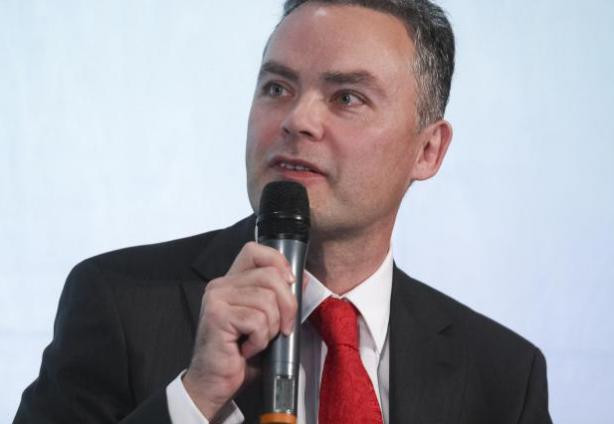
“If you can’t explain it to a layman,” the old adage goes, “you aren’t an expert” could not have been more appropriate than Monday morning, when Michael Ferguson, head of asset management at Ernst & Young in Luxembourg, delivered a succinct and compelling argument for the continuance of the hedge fund industry to a small, attentive audience in Merl.
Hedge fund managers are the “best of the best,” representing US$2 trillion in assets of the overall global pie that is roughly worth $53 trillion. Following a motto that is individualist, against the grain, these managers pursue a strategy that Ferguson calls “conviction management”, a style that is heavy on research, thought, analysis and unconventional tailor-made approaches to under-valued and over looked companies.
“One of the extraordinary things about hedge fund managers,” said Ferguson, “is that the best very rarely have finance degrees. They come into the industry from some other field, something that is research heavy, like biology, science or engineering.”
This message in particular could not have been delivered to a more appropriate audience. It is somehow telling that the most complex issues of today’s socio-economic landscape should be addressed by a world authority and delivered to high school students at the International School of Luxembourg. That unique, creative thinking permitted--even encouraged--in the hedge fund industry is exactly in line with Ferguson’s host, the ISL’s Young Enterprise class, something of a start-up lab, encouraging students to start businesses of their own, incorporate actual companies, make and sell products or services and, most importantly, acquire the skills to compete in the global economy.
In that spirit, the country is promoting courses like ISL’s Young Enterprise, part of a major nation-wide attempt to inculcate an entrepreneurial mindset into the youth of Luxembourg, entitled Jonk Entrepreneuren.
Hedge funds
Despite the economic crisis, the hedge fund market is growing and Luxembourg’s share in it represents nearly 10% of the total industry worldwide--something the Grand Duchy’s leaders hope will grow. Due to Luxembourg’s political stability, legal framework and unique ability to “passport” funds throughout the world, Ferguson contends that Luxembourg will increasingly become a major exporter of hedge funds, which will be a source of major, top level employment in the country.
ISL director Chris Bowman commented that having this message expressed by such a knowledgeable and highly respected person as Ferguson provides just the confirmation and incentive that the country’s students need.
But in the final analysis, the usefulness of a world class authority is in their ability to make very complex things very understandable.
“Think of futures derivatives as a farmer who agrees today the contract price for his crop which he will deliver to a market once it is harvested,” said Ferguson. “It is just the basic ‘futures contract’ that has been around for centuries.”
The Q&A between Ferguson and the students was perhaps most illustrative of this point. No matter how important the specialist, business always remains, in principle, a simple endeavour with a stated aim. “Do you have any tips on how we can make more money?” one student asked.
“My wife asks me that every day,” said Ferguson, to appreciative laughter.
Paul Comrie is a contract writer at the International School of Luxembourg