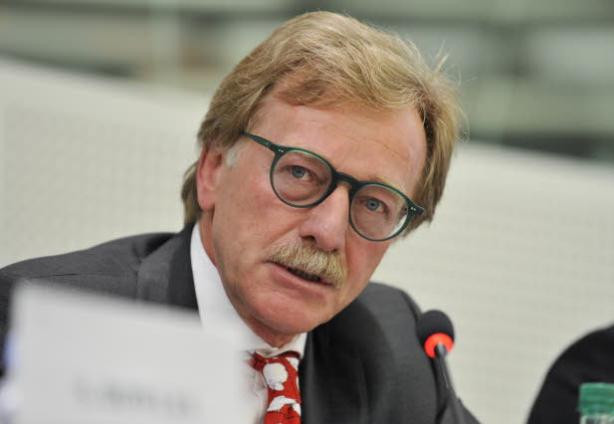
Yves Mersch, the Luxembourg member of the European Central Bank executive board, has called for “a truly integrated capital market” in the euro area that would allow smaller firms to break their dependence on local bank financing.
In a speech on Sunday, Mersch said: “Europe’s economy is characterised by small and medium-sized enterprises (SMEs). They account for two out of three jobs and generate around 60% of value added.”
Mersch was speaking at an exhibition of euro notes in Osnabrück, in Lower Saxony, one of Germany’s main manufacturing regions.
The central bank executive said that European SMEs: “finance themselves almost exclusively via the domestic banking sector. In most countries, however, the majority of loans to enterprises are granted by only a few banks. That makes the economy vulnerable towards, and dependent on, this sector.”
Mersch pointed to the US, where it is “quite usual” for companies to seek financing from capital markets, and firms frequently raise funds across state lines.
The ECB board member then stated: “In a monetary union one should also expect a fully integrated capital market. That would mean, for example, that a creditworthy entrepreneur from Osnabrück could issue a bond without any problems in the Netherlands. Or an entrepreneur from Lisbon could do the same in France. After all, France, Portugal, the Netherlands, Germany and 15 other countries share the same currency.”
He added: “A truly integrated capital market would not only benefit the European economy because it would ensure an efficient and location-independent allocation of financial resources. It would also bring with it a greater distribution of risk.”
Small firms, big part of economy
According to Luxembourg’s statistics agency, Statec, roughly 97% of firms in the Grand Duchy have less than 50 employees. Separate figures from the EU statistics agency, Eurostat [PDF], showed that 70.3% of Luxembourg employees in the “business economy” worked for SMEs, and SMEs produced 72% of “added value” to the Grand Duchy’s economy in 2012.
Mersch has sat on the ECB’s management board since December 2012. Before taking that seat, he was head of Luxembourg’s central bank for 14 years.
On 22 January the ECB announced that it would buy €1 trillion in public and private bonds, in a “quantitative easing” programme, in a bid to stave off deflation.