Since the OECD began assessing the literacy and numeracy performances of 15 year-olds worldwide, Luxembourg has ranked poorly. The results of the 5th PISA study revealed Tuesday showed little development: students in the Grand Duchy still perform below OECD average.
Indeed, Luxembourg’s average mathematics score has not evolved in 10 years. With pupils here obtaining 490 points in maths (the international average is 494), 488 points in reading (average is 496) and 491 in science (average is 501) there seemed to be little reason to rejoice.
Especially taking into account the scores of the top performers (Shanghai-China, Singapore and Hong Kong-China took pole positions in all three topics with scores between 613 and 542), but also comparing with the neighbouring countries. Students in Belgium, Germany and even France all performed better than those in Luxembourg.
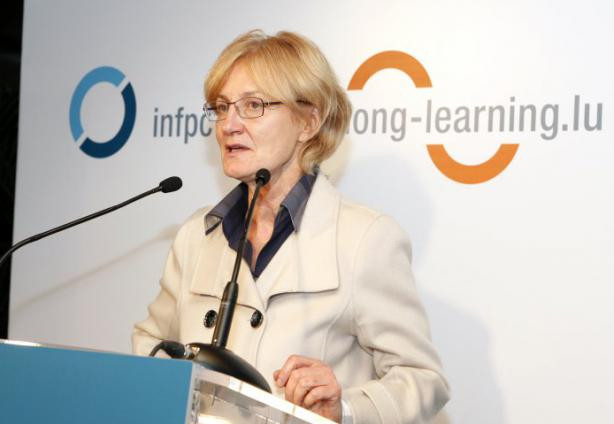
And yet, Mady Delvaux-Stehres, still minister of education for a few more days, found a reason to be positive. “I’m very pleased with the progress made in reading compared to the last study in 2009 [+16 points], and also in science [+7 points]. It’s also reassuring to see that the students who are part of the PROCI pilot project in the lycées techniques score better than their peers in the traditional classes. It confirms that we’re on the right track.”
Disturbing socio-economic and gender gaps
Most disturbing is perhaps the social attainment gap in Luxembourg, amongst the highest in the PISA survey. The impact students’ socio-economic background has on education outcome is quite disheartening: underprivileged students score 93 points less than their privileged peers in maths, 94 points less in reading and 108 points less in science--which amounts to a two year delay of education.
Overall, 39% of Luxembourg students lag behind in their schooling and only 1% are considered to be in advance.
Equally worrying is the enormous gender gap. Luxembourg tops all other European countries in this area in maths (and comes in second out of 65 countries overall, just behind Colombia) as well as in science, with an even larger gap between boys and girls than in previous studies. In reading, however, as is the case in every single PISA-tested country, girls outperform boys.
Languages: not so much of an advantage
While visitors to the Grand Duchy often admire a school system where students learn to wield three languages, the multilingual teaching seems to be detrimental when it comes to performance.
“We have yet to adapt our system to the heterogeneous population in our schools,” insisted Delvaux-Stehres. “To get better results, we must take the different language profiles into consideration early on and offer instruction better suited to each individual.”
Compared with the other countries in the PISA study, Luxembourg has the highest rate of 15-year old students with a migration background (43.2 %), with much more than half of them speaking another language than Luxembourgish at home.
Last year 510,000 students from 65 countries (34 OECD countries, 31 partner countries) were PISA tested. In Luxembourg, 5,258 students from all 42 secondary schools (public and private lycées and lycées techniques as well as international schools) took part.
The detailed PISA 2012 report is available on the OECD website.