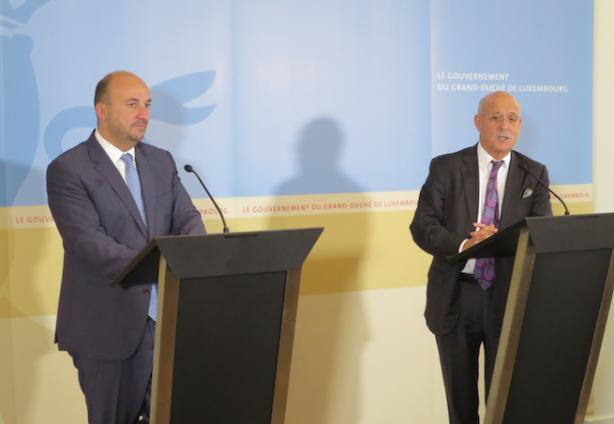
Last Thursday Luxembourg’s economy minister, Étienne Schneider, launched, in the presence of Jeremy Rifkin, a project for a new supply side policy intending to reorient aggregate supply to new objectives and to address the economic and environmental challenges of this century.
The project refers to Rifkin’s thesis of a third industrial revolution called the “internet of things” (IoT) and based on a complete digitalisation in three domains: communications, energy and transportation.
From an economic point of view this IoT has to be considered as a kind of public good, in this case, a service that no user can be excluded from and for which the use by one user does not reduce the quantity and quality available for other users.
The expected outcomes (over the next 35 to 40 years) for an economy that adapts successfully to this concept should be a more efficient use of scarce resources combined with a lower impact on global warming. Another consequence should be strong structural changes on the labour market: a net job creation is expected due to the fact that jobs will be created in the sectors in charge of building up the necessary infrastructure for the IoT (ICT, telecom, consumer electronics, electricity, power generation and distribution, logistics, etc.), and in the non-profit organisations whereas jobs in more traditional sectors will be expected to disappear.
These changes will lead the economy to a new hybrid system, a mix of a capitalist and a sharing economy having an impact on the structure of the existing firms.
These structural changes have to be accompanied first of all by a change in mentality of all the participants in the economy: a shift from thinking in terms of competition to thinking in terms of cooperation and sharing will be needed.
Free access needed
To make this system work the government has to guarantee that the IoT really works as a public good, meaning that free access to IoT at constant quality will be granted for every user and that the risks of monopolies and cyber criminality due to the existence and use of “big data” will be minimised as far as possible.
As a public good by definition does not allow the generation of profits due to its particular characteristics, incentives for private investments (through crowdfunding, for example) have to be developed apart from the public investments needed to develop IoT. One possibility could be that traditional market oriented firms invest in IoT to be able to supply commercial services to the users.
A final change will be the new structure of fiscal and social policies of the government as the developing sharing economy will generate less revenues to all participants and hence will not allow to pay the same amount of taxes as in a traditional market economy. Again, a strong change in mentality will be needed to make this ambitious project a success story for the next generations and an example to follow for other countries.
Carlo Klein teaches economics and social sciences at the Athénée de Luxembourg and international economics at Miami University in Differdange.