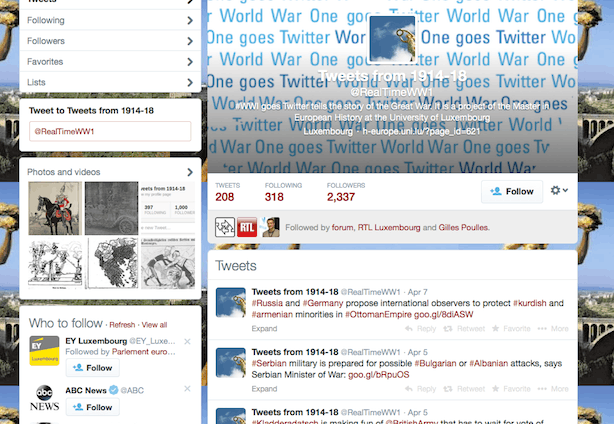
Masters of modern European history students at the University of Luxembourg are using Twitter to breathe life into the history of the First World War.
The tweets are published in “real time” one hundred years, day for day and even hour for hour after the event they recount. By relaying the events of the infamous conflict in just 140 characters the project is helping to make history accessible in the modern era.
According to Benoit Majerus, the associate professor running the project, they “hope to reach a different public than with more traditional ways of communicating history such as books and articles”.
Perhaps most importantly, the project is also providing the four classes of students involved with invaluable information and research skills as well as “a new tool to narrate their (hi)stories”, he told Delano on Tuesday.
Twitter is proving itself to be a popular, albeit unlikely medium for the commemoration of the First World War: the @RealTimeWW1 account has gained over 2,000 followers since its activation in May 2012. With over 200 tweets already published and more than 1,500 others in the pipeline, it seems the project is on its way to being a major success.
Following WWI day by day
Majerus went on to say that the Twitter account makes it possible to follow “day after day, hour after hour, the sequence of minor or major events that make up an international conflict”, something which is a simple ability of modern life and yet is incongruous with a conflict long passed such as the First World War.
In this way, the tweets often closely resemble headlines from current conflicts, especially the recent tensions in the Crimean Peninsula and the UK’s debate over splitting from Europe.
This project is part of the “digital humanities” movement and is what Majerus described as “a larger transformation of analysing knowledge and telling stories thanks to new digital tools”.
The @RealTimeWW1 account follows in the footsteps of projects such as the @RealTimeWWII account run by Allwin Collinson and the University of Oxford’s @Arras95 that covered the battle of Arras 95 years on.
The @RealTimeWW1 account will stay live until 2018 when it will describe the first years of the post-war period.