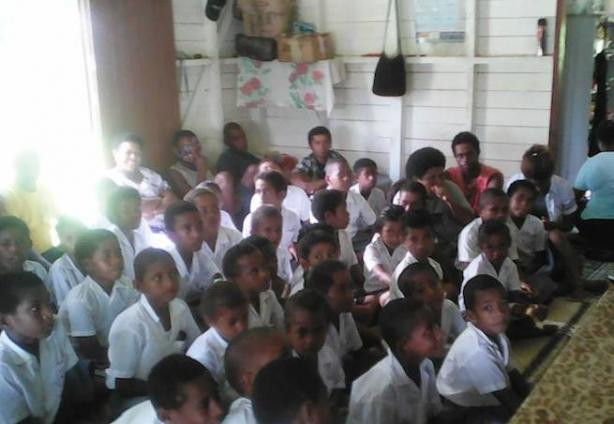
The Vabea district school had been without electricity for the last five years. Located on Ono Island in the Kadavu group in the south of Fiji’s main island, Viti Levu, some 43 students learn for their future, educated by three teachers. Located in a valley behind the villages of Waisomo and Vabea, the school teaches children from these two villages as well as from Narikoso village, a 30 minute boat ride away.
Based on my earlier involvement in the development of energy projects in Fiji and motivated by my studies there at the University of the South Pacific, a delegation of Engineers Without Borders Germany and Engineers Without Luxembourg Luxembourg visited Ono island and other locations in Fiji back in 2013. Some funding from the German embassy in Wellington, New Zealand, was approved, so that the European partners returned to the Vabea school for an electrification project.
Following the idea of global knowledge exchange, the European team was supported by members of the Fiji National University and one of their professors. Motivated by our project idea, the FNU participated for the first time in such a project, directly involving villagers and serving their need of a reliable electricity supply. Therefore, the university administration sent a team of four people, consisting of Professor Paula Tuivanuyalewa and three technicians, and students with us to install a solar photovoltaic system on the roof of the school.
Once arrived in Ono, after a 12 hour ferry ride and adventurous 40 minutes in a speedboat, the team directly started, supported by a technician from a local solar supplier, to look for a location for the solar panels. Using already existing electricity lines running to each school building, once fed by a diesel generator, the best location related to the grid and the direct sunshine of potential roofs was chosen.
It took us three days to connect the system with the existing grid and to supply power to the system. We experienced curious and nervous kids, having for the first time steady electricity in their school. The kids from the Narikoso village, who have to stay the week in school from Sunday to Friday, will especially benefit from the electricity supply. During our stay the system 1.2 kW solar system generated a maximum of 4 kWh per day and stored excess energy in the 10.8 kWh battery storage.
Local training
An extensive training of teachers and villagers, which lasted three days with two daily 45 minutes lessons, explained how the systems work and how to maintain the battery storage and to calculate their energy demand. The positive feedback of those training sessions encouraged the team to follow up on that training concept during future projects.
Working together with the German and Luxembourg EWB members on the project, the Luxembourg team was in the lucky situation to learn from the German counterparts. Due to a lack of donations in Luxembourg the main cost was carried by the German partner.
The future involvement of EWB in Ono Island concerns the renewable energy supply of an entire village, of a maximum of 20 houses. Furthermore the installation of a Pico Hydro scheme is planned in close vicinity to the school. Within this project two additional villages got solar home systems, consisting of a charge controlled battery, four lights and USB charge connector for mobile phones. The idea is to train the villagers with the small system to learn the limits of a solar supply and to install in future missions some larger solar or other renewable systems for the energy supply in their villages. EWB Luxembourg is financially supporting the further exploration of potential project sites by the FNU delegation.
International team
The idea of involving locals in the EWB Luxembourg projects was already successfully applied in the India exploration in last December. By creating an international team, consisting of European and local participants, an optimum knowledge exchange is assured. Furthermore, by investing in exploration missions new projects can be developed together and implementations can follow.
For projects in Fiji and India, we have been supported by two donations from ANEIL (the National Association of Luxembourg Student Engineers). Thank you for that!
Please feel free to contact us directly (contact@ewb-luxembourg.org) or attending a meeting at the EWB Luxembourg office at the University of Luxembourg’s Kirchberg campus.
David Norta is a PhD candidate at the University of Luxembourg and president of Engineers Without Borders, which can be found on Facebook. The NGO was profiled in the Delano November 2014 cover story.