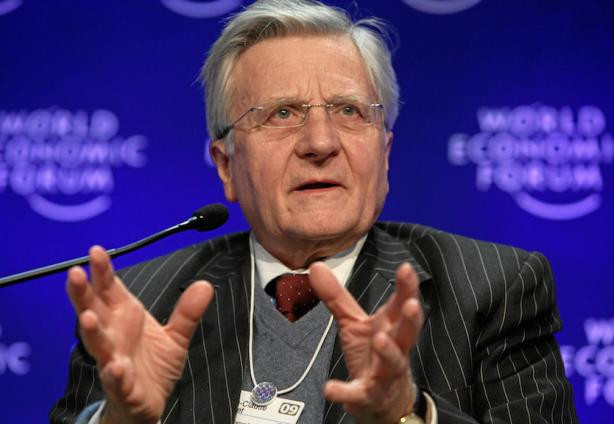
“We avoided a great depression and as a result we have a tendency to underestimate the gravity of the position after the Lehman Brothers collapse,” according to Jean-Claude Trichet, who was president of the European Central Bank between 2003 and 2011 and governor of the Bank of France for the decade prior to that. “Had the central banks, governments and parliaments of the advanced economies not had the capacity to act swiftly and boldly, we would have had the very cruel experience of a great depression.”
Trichet was speaking at a conference held at the Philharmonie in Luxembourg on Monday entitled “Economic, fiscal and financial governance of the euro area: Lessons from the crisis”. The event was organised by the European Stability Mechanism and European Financial Stability Facility, the EU’s two sovereign debt bailout agencies, also located in Kirchberg.
During the forum, Trichet, considered the background and implications of the economic meltdown that began nearly nine years ago. Trichet began by saying that this was not just any crisis, but “the worst financial crisis since World War II” and he warned that we are still in its shadow.
He went on to chart the crisis using three “over-simplified” episodes. First, the “generalised financial turbulences” which began in August 2007 and terminated in September 2008. The ECB decided to provide unlimited liquidity to banks, advancing €95 billion.
Second, “the grave and immediate threat of a full collapse of the financial system of the advanced economies”. The Lehman Brothers bankruptcy was announced on Monday 15 September 2008, at which point the credibility of all counter parties was placed in doubt.
Third, “the morphing of the crisis from a private signature financial crisis into a public signature financial crisis.” This was a global crisis and investors were questioning both public and private debt. At the end of 2009, the epicentre crossed the Atlantic into the euro area, which combined some of the best and worst debtors. That helped explain why the euro remained solid.
Europe: worst performance
Trichet then went on to provide six reasons why he believes we presented the worst signature in the advanced economy: we did not respect the stability and growth pact; we did not monitor the overall competitiveness of the countries in the euro area in the naïve belief that a good market should self-correct; we had no tools to cope with the dramatic crisis which called for a systemic response; we had no banking union so the sovereign bank nexus created by the crisis meant there was a high level of correlation between the credit worthiness of the countries and of the banks; the absence of full completion of the single market--the euro area in particular needed a fully functioning single market; and the Lisbon Agenda structural reforms dealing with full membership of the EU were not fully-implemented.
“To say all this is the fault of the ECB is wrong,” stated Trichet. “The ECB was there with a fully fledged mandate to deliver price stability without inflation and without deflation, which is what it has done. We’re below a 2% yearly average and our fear of inflation has vanished.”