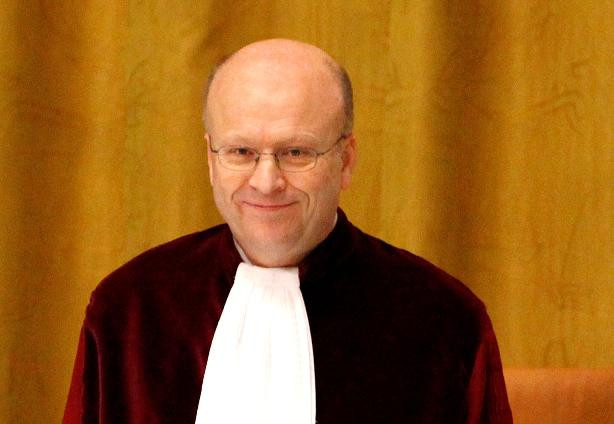
Delano’s February cover story takes readers inside the European Union’s Court of Justice in Kirchberg. In a five part series, Delano.lu has been featuring exclusive interviews with the court’s president and one of its long-serving judges.
Law professor Koen Lenaerts, who previously represented his native Belgium before the ECJ, has been a judge in Kirchberg since 1989 and currently is president of the Third Chamber. Today he talks about the role that the court plays within the European and national member states’ legal systems.
AG: How is it different being a jurist at the Court of Justice versus a judge in a member state’s national legal system?
KL: EU law is authentic in 23 languages and may use terminology that sounds familiar to some national legal systems, whilst it is unclear or even has a different meaning in others. That is why national courts refer for preliminary rulings on the interpretation of EU law to the ECJ, which on the basis of its multinational and multilingual composition has the expertise to give an authoritative interpretation of that law. Member state courts then put those preliminary rulings into effect within their domestic legal system.
AG: In your view, why is the court an important part of the European Union?
KL: First of all, there is the principle of pacta sunt servanda, i.e., all member states as well as the EU institutions themselves must respect the treaties on which the EU is founded. Compliance with EU law is crucial because member states cannot back out from EU law on the ground that another member state fails to fulfil its obligations.
The idea behind it is that the ECJ has the necessary jurisdiction to make every member state stick to its commitments under EU law. Besides, the ECJ upholds the legality of the actions undertaken by the EU institutions and bodies. This is important for the long term legitimacy of the EU as a common governance structure acting in those policy fields where the EU is to produce added value in comparison with potential policy outputs at national level.
AG: Does Europe have a constitution?
KL: It flows from the answer given to the previous questions that the treaties on which the EU is founded, as well as the Charter of Fundamental Rights of the EU fulfil, as primary EU law, the same role as a constitution in a nation-state, i.e., that of the ultimate norm that must be respected by all other norms for them to be legal.
In that sense they operate as a ‘constitution’ at the top of the hierarchy of norms of the EU. They give the EU a self-referential ultimate constitutionality check, like ‘constitutions’ do in nation-states.
But all of that does obviously not mean that they are as such ‘constitutions’, simply because the EU is not a nation-state, nor does it intend to become one. It is rather to respect the national identity of its member states, including their constitutional structures.
Wednesday: Lenaerts tells Delano what amazed him most about the ECJ and shares his take on the future of the court.