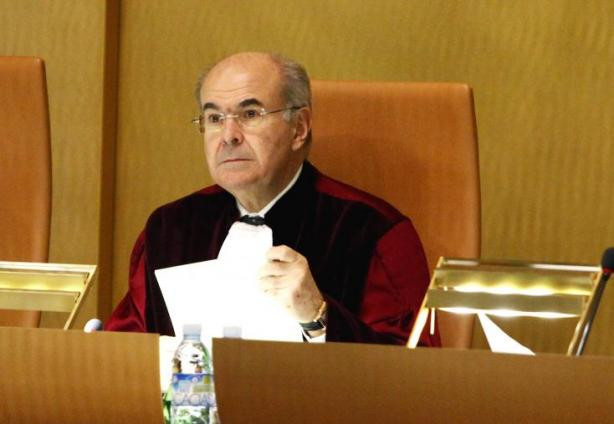
On Thursday, Vassilios Skouris, president of the European Union’s Court of Justice talked about why the Luxembourg-based institution is a vital part of European integration and on Friday he discussed the types of cases handled by the court. Today Delano asks Skouris about the challenges of running a large, multilingual organisation.
AG: What is the principle of multilingualism and why is that important part of the court’s functioning?
VS: The EU has 23 official languages and the EU institutions must be able to function in all those languages. As regards the Court of Justice in particular, multilingualism is of paramount importance because the case-law of the court must be accessible by national judges and European citizens in all 27 member states.
AG: It must be difficult to hear cases in a multilingual environment. Are there specific procedures or precautions that the court and its jurists take to ensure that all parties receive a fair hearing but that cases still proceed efficiently?
VS: I can confirm that the system of integral multilingualism under which the court operates is not devoid of complexity. Nevertheless, our translation and interpretation departments have managed up to now to meet the challenge of running efficiently and within reasonable time-limits. This is why the overall efficiency of the Court of Justice has improved significantly over the last ten years.
AG: In addition to being the chief judge, you are responsible for the administration of the court. What are some of the complexities of managing an international institution?
VS: The court is a rather big organisation, with more than 2,000 employees, which is mainly administered by the registrar with the president having a general overview.
The court’s administration is structured in four directorates general, several directorates and dozens of administrative units. It is installed in a building complex which is constantly under expansion and has to face an ever increasing workload over which it has no control.
It hosts the largest library specialised in EU law in the world and requires an overall budget of more that 300 million euro which must be managed above all with respect to the taxpayer and in conformity with EU financial regulations.
Tuesday: One of the court’s long-serving judges talks about the role that the court plays within the European and national member states’ legal systems.