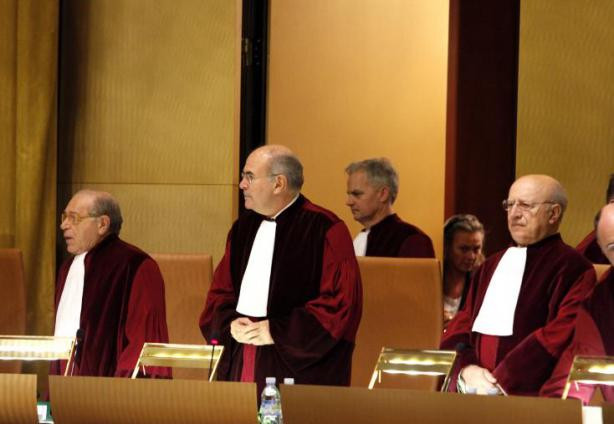
On Thursday, Vassilios Skouris, president of the European Union’s Court of Justice (photo, centre) talked about why the Luxembourg-based institution is a vital part of European integration. Today he discusses the types of cases handled by the court.
AG: How many judgments has the court issued in its history and has that number increased in recent years?
VS: All the EU courts combined--the Court of Justice, General Court and Civil Service Tribunal--have rendered over 18,000 judgments and orders since the creation of the court in 1952.
In recent years, the caseload of the EU courts has increased dramatically primarily due to the enlargements of 2004 and 2007and the entry into force of the Treaty of Lisbon.
AG: Is there a type of case that has increased in recent years?
VS: Over the past few years we have had a notable increase in tax cases and cases arising from the so-called EU area of freedom, security and justice: immigration and asylum, judicial cooperation in civil and criminal matters, etc.
AG: Some European leaders are proposing that balanced budget rules be enshrined into the constitutions of member states and violations be judged by the Court of Justice. Is this a good role for the court?
VS: The Court will interpret and apply any EU law rules within the limits of its jurisdiction and competencies as they are provided for in the treaties.
AG: Why can’t jurists comment on specific cases that they’ve handled?
VS: We feel that it is something that should be avoided. Such commentaries could give the impression that they constitute an ‘authentic’ interpretation of a ruling or that they reflect the discussions that took place during the deliberations, which are secret.
Monday: Skouris addresses the challenges of running a large, multilingual organisation.