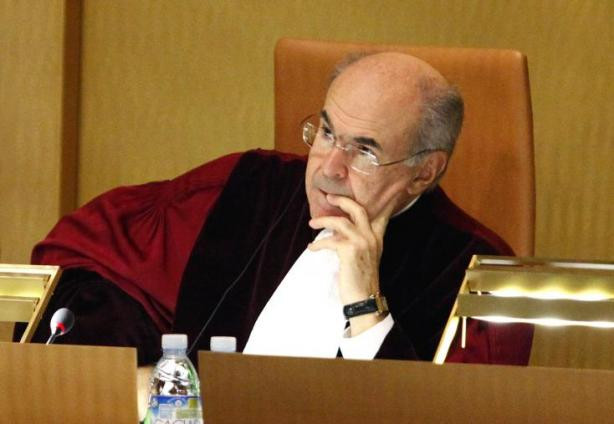
Delano’s February cover story takes readers inside the European Union’s Court of Justice in Kirchberg. Over the next week, Delano.lu features exclusive interviews with the court’s president and one of its long-serving judges. We begin with Vassilios Skouris, a law professor and two-time interim Greek interior minister, who became a judge at the court in 1999 and then its president in 2003. Today he talks about why the Luxembourg-based institution is a vital part of European integration.
AG: Why did you decide to join the Court of Justice when the opportunity arose?
VS: Citing a popular cultural reference from a famous book and film, it was an offer I could not refuse. The opportunity to participate in the shaping of EU law is really unique and utterly fulfilling both intellectually and culturally.
AG: What is the role of the Court of Justice, both at the European Union level and in terms of working with the 27 national legal systems?
VS: The European Union is above all a community of nations based on the rule of law. The fundamental role of the Court of Justice is to ensure that the rule of law is respected throughout the European Union. In addition, the close cooperation between the Court of Justice and national courts allows the former to guarantee the uniform interpretation of EU law in all the member states.
AG: What are the differences between European and member state law?
VS: I would not use the word ‘differences.’ Each legal order has its set of rules, its body of legislation. The European Union is such a legal order. As regards the relationship between EU rules and national legislation the EU treaties and the case-law of the Court of Justice provide for the principle of primacy of EU law.
AG: In your view, why is the court an important part of the European Union?
VS: Precisely because the EU is based on the rule of law. There is no point in having a community of nations based on the rule of law without having the necessary mechanisms in order to ensure the enforcement of this principle.
Friday: Skouris discusses the types of cases handled by the court.