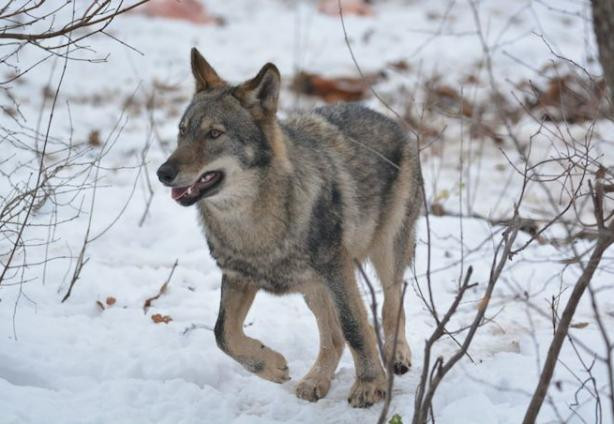
Last December a study published in Science found four “large carnivores” were making a comeback in Europe. “Sustainable populations of” predators including the brown bear, Eurasian lynx and wolverine “persist in one-third of mainland Europe”, reported the paper’s authors. But it is the fourth species, with its heavy cultural baggage, that has the potential to create the biggest stir in the Grand Duchy.
That would be the wolf. Indeed a suspected case of a sheep killed by a wolf took place in September in Saarland about 80km east of Schengen (at press time the results of a DNA test were pending). The last known wolf in Luxembourg was shot in 1893 near Betzdorf, but wolf packs are now reproducing in the Vosges mountains and a solitary wolf lives about 70km south of the Grand Duchy, “about a night’s walk for a wolf”, according to Laurent Schley, deputy director of Luxembourg’s nature conservation and forestry department.
When I asked why the wolf population in Europe is recovering, Schley answered: “First you have to know why they went extinct”. A century ago, when “rabid wolves bit people and livestock, [they] died because they had no vaccine”. Also back then the food supply depended more on hunting, so wolves were simply seen as a “dangerous” and a competitor for dinner. And they were essentially wiped out.
Things started changing with the passage of Italy’s 1976 protection act (when that country had a wolf population of around 100), followed by the Bern Convention in 1979 and European Habitats Directive in 1992. In 1992 wolves crossed over from Italy into France, says Schley, who earned a doctorate in biology from the University of Sussex. Since then the total European population has grown to between 12,000 and 18,000, although none apparently yet have settled in the Benelux region.
Ready for wolves
That is likely to change and “we could expect wolves to show up in Luxembourg” tomorrow or in 10 years’ time. “We don’t know; we’ll see. But as a country we have to be ready. [Because] when it happens there can be conflict.”
Conflict mainly arises when sheep, for example, are killed. Biologists can take samples of the wounds and DNA in saliva often can identify the culprit. “Not every sheep is taken by a wolf; quite a few sheep are taken by dogs.”
Schley’s department is setting up a wolf attack compensation programme based on Luxembourg’s existing system for damage caused by protected species. Sceptical the payments will cover their losses, over the summer Convis, a farmers trade group, called for “effective wolf management in Luxembourg” and questioned the animal’s benefit to biodiversity. But the hunters group FSHCL said it “welcomes this natural return”.
Free seminar
Partly to bridge this gap and partly to educate the public that there are “no wolves looking for children” out there, Schley is holding a series of open seminars on the animal’s return. One in English takes place Monday 9 November, 7:30 p.m., in the Bâtiment des Sciences at the University of Luxembourg’s Limpertsberg campus.