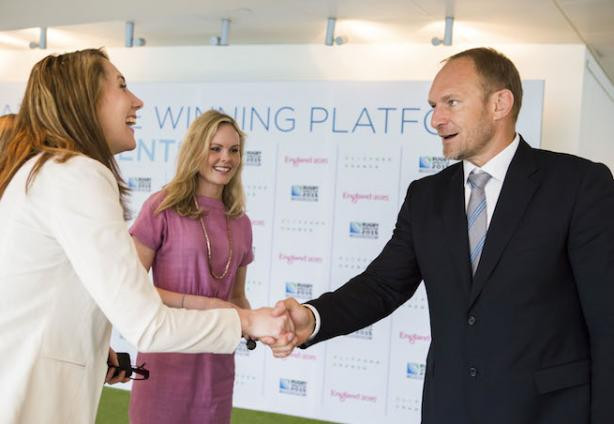
He was portrayed by Matt Damon in “Invictus”, the film about South Africa’s big win in the 1995 Rugby World Cup and what it meant for national reconciliation. In real life Francois Pienaar trained as a lawyer, served as board chair of South Africa’s oldest bank, and led his country’s (unsuccessful) bid to host the Rugby World Cup again in 2011.
Pienaar is in Luxembourg this week at the invitation of the law firm Clifford Chance to host a charity auction of rugby memorabilia. The event will raise funds for Ile aux Clowns, a group that aims to improve the quality of life of children and elderly patients in hospitals and care facilities.
Clifford Chance, a sponsor of the 2015 Rugby World Cup, is organising the fundraiser to help mark its 15th year in the Grand Duchy.
Pienaar was named South African rugby player of the year in 1993, international rugby player of the year in 1994 and international rugby captain of the year in 1995. He stopped playing professionally in 2002 and was inducted into the International Rugby Hall of Fame in 2005.
Delano spoke with Pienaar via email in advance of the fundraising event, which will be held on Wednesday.
AG: Let’s start with “Invictus”. Obviously it’s a Hollywood movie and so dramatised, but how accurate would you say it is in telling your and your team’s story?
FP: “Hollywood has taken a lot of ‘licence’ and the end result is mixed, portraying the team as ultra conservative and being forced to do coaching clinics in the townships is far from the mark. The team was progressive and we did the coaching [of our] own volition.”
AG: What do people frequently misunderstand about the film and the real life story?
FP: “The overall narrative that Mr Mandela was the architect of our win is not accurate. He embraced rugby as a nation builder and understood the power of sport but the innate desire to win rested with the team.”
AG: Do you feel a bit “stereotyped” by people always asking about the film?
FP: “Not at all, it was one of the most magical moments in our country’s history; 20 years on it is amazing how the match resonates with South Africans, in particular people from disadvantaged background who suffered under apartheid.”
AG: What have you been doing since your rugby playing days?
FP: “I have my own business interest focusing on media rights and events.”
AG: Is this your first time in Luxembourg?
FP: “Yes, I’ve been wanting to visit for a while so I’m pleased to be here--although I wish I could have stayed for longer.”
AG: Why is it important for you, personally speaking, to be involved in charitable and fundraising programmes?
FP: “I have been blessed to play sport at the highest level and giving back to society that has supported us is important. It is a privilege to [be] able to help people that are less fortunate.”
AG: What are the simplest lessons, in your view, that can be applied from the pitch to the business world?
FP: “Hard work, the more you put in the more you will get out in return. Only one place where success comes before work and that is in the dictionary. There are a number of lessons between business and sport--such as: teamwork; investing in people; and leadership. You’ll see these skills learnt on the pitch but also in professional environments like Clifford Chance. I will also touch on these in my talk [during the fundraiser].”
AG: What makes a good teammate?
FP: “People are all different and there is no set recipe for a good teammate. If he has strong values, works hard, loves pressure and understands the team comes first, that type of person can be in my team any day.”