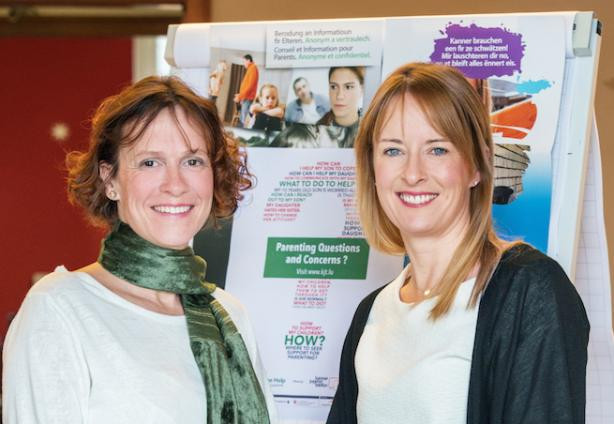
Luxembourg’s first English-speaking helpline for families and children, entirely staffed by volunteers, launched on 14 January. Kanner Jugend Telefon started offering confidential telephone help in the Grand Duchy’s official languages in 1992 and added online support 13 years ago; volunteers began working on an English programme in 2012.
Callers and web users do not need to specify their name or where they live when they phone or connect to the online portal. KJT says volunteers will listen respectfully and then provide guidance and suggest resources, but the organisation does not directly intervene itself.
The group says on its website: “We don’t have an answer to every question, or a solution to every problem. We are, though, open to every sort of request and type of subject-matter and we are absolutely sure that it is always worth talking things over.”
Whether the problem relates to school, the Luxembourg lifestyle or puberty, the helpline will rise to the challenge, says Joanna Gilbride-West, a psychologist who trained many of the English-speaking volunteers. If needed, “we bring in professionals” to provide follow-on support.
Just as callers and online users remain completely anonymous, so do the volunteers who listen and provide guidance to the kids, teens, parents, friends and family members, and concerned neighbours who get in touch.
Such discretion comes at a cost to public visibility. “The struggle is to be recognised,” Joanna says of the group. The free service relies on donations to cover operating costs and the team is in need of funding to update the service, she tells Delano. In addition to private donors, KJT is supported by the family ministry and three main sponsors: Docler Holding, ArcelorMittal and the Luxembourg Hearts Rotary Club.
Before staffing the helpline, volunteers take a formal instruction programme that lasts between 70 and 130 hours over a ten month period, according to Lynn Frank, who also trained English-speaking counsellors. She describes the volunteers as “an international group of men and women.”
A survey of parents and children taken prior to the launch found that 90% of people thought the English helpline would be useful, say Joanna and Lynn, both mothers.
The most important goal for them is to gain more exposure with the public, so that people don’t feel embarrassed or scared to look for help. “We want to stop the idea that it’s for emergencies,” according to Joanna. “It could be a safety net for people.”
Lynn explains that “having been a parent, it can be hard away from peers, family, language group” when they move abroad.
Currently the English helpline is solely for family problems, however the group aims to open a separate helpline dedicated to children in June, as well as develop their website to be more simple and functional.
They envisage a day where a helpline number is available on every child’s phone, as common as the police or emergency services.
Lynn, who earned a degree in psychology and previously worked as a helpline manager in the UK, got involved after seeing an advert asking for volunteers. KJT is not actively seeking new counsellors at the moment, but there will bea new training group organised in the future.
For family support in English, check the KJT website or phone: 116 111.