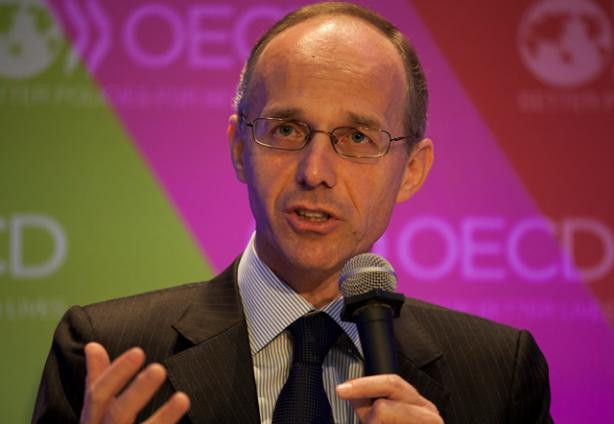
As part of the government’s campaign to increase its level of international tax cooperation, the Grand Duchy has officially initialled a benchmark agreement among more than four dozen nations. On Wednesday finance minister Luc Frieden signed the Convention on Mutual Administrative Assistance in Tax Matters at the OECD’s Paris headquarters.
The accord serves as an “international standard for the automatic exchange of information in tax matters”, according to the finance ministry.
The move “is an important step for Luxembourg”, Frieden said during the signing ceremony, the ministry reported. “It shows our commitment to implement the principle of automatic exchange of information which is however only efficient if it is implemented on a global level.”
The ministry added: “this international agreement is a framework that serves as a model for future negotiations on bilateral tax cooperation matters.”
In addition to the Grand Duchy, representatives of Austria, Belize, Estonia, Latvia, Nigeria, Saudi Arabia, Singapore and the Slovak Republic signed the convention during the ceremony in the French capital, while Burkina Faso, Chile and El Salvador signed letters of intent, and Belize, Ghana, Greece, Ireland, Malta and the Netherlands and its Caribbean territories and Aruba, Curaçao and Sint Maarten “deposited their instruments of ratification” the OECD said in a separate statement.
This brings the total number of participating countries to 53.
“With taxpayers increasingly operating worldwide, tax authorities are moving from bilateral to multilateral cooperation and from exchange of information on request to other forms of co-operation such as automatic exchange of information,” the OECD commented. The organisation, a think tank funded by 34 rich world countries, said the convention “complements other initiatives” such as the EU Savings Directive.
On May 22, Luxembourg’s government said it was likely to finalise a tax data sharing covenant with Washington, as required by America’s FATCA legislation.
Base erosion and profit shifting
Frieden then spoke at a seminar entitled “Too big to pay tax” that focused on the “BEPS” issue, or “base erosion and profit shifting” (photo), which was held in response to the debate over cross-border taxation of multinational corporations, which has put the practices of firms such as Amazon, Apple, Google, Starbucks and Vodafone in the spotlight.
The minister said “Luxembourg fully shares insights around BEPS and obviously double non-taxation cannot be tolerated”, the Grand Duchy’s finance ministry stated.
“It is essential to ensure effective taxation and, to achieve this goal, it is essential to find a balanced system with criteria respecting the international aspect of trade and competitiveness activities and avoid the risk of a re-nationalisation of markets,” Frieden said.