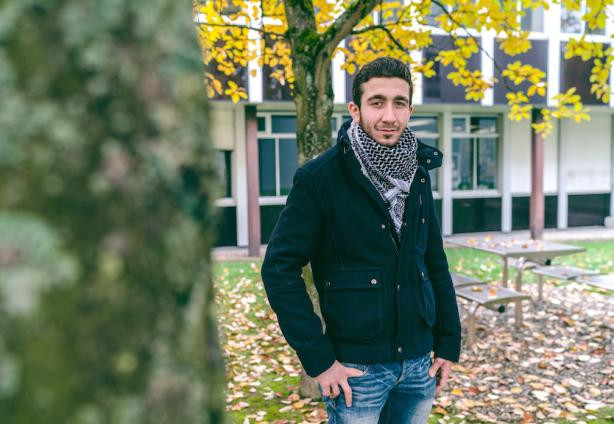
When I met Ayham Bawadukji after class one afternoon recently, he seemed like so many 20-somethings in Luxembourg. Backpack casually thrown on the floor, he struck me as friendly and open minded, nicely put together in the way that only cool students on a budget can pull off, and slightly unsure of precisely what I wanted to speak to him about. I just wanted to hear his story.
Ayham arrived in the Grand Duchy nearly a year and a half ago and is currently a “guest student” at the University of Luxembourg. He was in the middle of his third year in electrical engineering when he left his home country. He’ll formally continue studying when his German improves. Right now, “I’m not that good in the language,” he says in English, which is why he is auditing courses this academic year.
While his older brother and sister also reside in the Grand Duchy, Ayham lives with a Luxembourger named Geneviève. She was “the first Luxembourger I had met” and beforehand he wasn’t even sure if they’d get along. “I’m not going to lie, I had some fear that Luxembourgers were scared of us or they hate us or something. So after I met Geneviève, she let me meet her friends, her family, and I saw how nice these people are.” He says socialising with Geneviève has “helped me a lot to integrate into this society” and that “she’s the best, really the best.”
Like so many students, money’s tight. Since he is under 25, Ayham is not eligible for Luxembourg’s public financial assistance scheme. Each month he does receive a €25 cash allowance and a transit pass from the government, plus each week €50 in food bank vouchers. At press time he was also expecting three months of top-up aid from the City of Esch-sur-Alzette. And if he officially registers at the university next year then he’ll be eligible for an education ministry bourse. So he’s not complaining: “I’m living, I can live, I’m happy.”
Why he left home
Ayham is officially a refugee in Luxembourg. He left Syria on 18 December 2013. He grew up and was attending university in Damascus when the “Arab spring” revolution began in 2011, he tells me. “I was against the regime, Bashar al-Assad, and I was a photographer” providing pictures and videos to activists. After two years, the regime threw him in jail. “I stayed two months and five days. I had been tortured there. It was a really horrible situation there. I saw people tortured to death.”
“I don’t know how I got out” of jail, Ayham states. “I tried to continue university but it was impossible. Everyone was looking at me, everyone was checking on what I was doing. I’m not gonna shut up and do nothing and live my life like there’s nothing happening in Syria.” But he feared a return to jail would be a death sentence.
So after talking with his parents, he entered Turkey where he tried to settle in. “It was so hard without papers… I wasn’t allowed to study or to work, and I wanted to continue to study, so I thought to come here to Europe. And I managed.”
Ayham hopes “to really be fluent in the German language” soon and continue his engineering studies here or at the prestigious university in Aachen (“I want to learn French too; it’s a beautiful language”).
He hasn’t faced much hostility in the Grand Duchy. “I don’t want to say it never happened, but it’s rare.” At the same time, “most people are scared to ask personal questions, like ‘what happened to you in Syria?’,” or about being tortured in jail, but Ayham feels “free” to talk about those experiences. Although his voice seemed to quiver a bit when he was telling me about it.