About €2 billion in EU development funds for Greece administered by the Kirchberg-based European Investment Bank “is likely to be delayed until 2013,” the Financial Times reported on Tuesday.
The two funds, meant as a lifeline for Greece’s economy, come from the European Commission and the EIB, but are dispersed via the EIB and the Greek government. One fund focuses on small and medium-sized enterprises, who have been cut-off from normal bank lending as a result of the euro zone crisis, while the second aims to un-freeze energy, transport and education projects halted under Greece’s austerity budget.
But the European commissioner for regional development claimed the EIB was “dragging its feet” in an interview with the FT. Johannes Hahn “accused the EIB of being overly concerned about protecting its triple A credit rating,” according to the financial daily. “I’m not quite happy that it has taken such a long time,” the commissioner is quoted by the FT as saying. “It could be faster and it should be faster.”
The newspaper also cited Costas Mihalos, the president of the Athens Chamber of Commerce, saying the EIB was “deliberately holding back in order to protect its balance sheet.”
In response, the EIB has said more progress on the two special Greek funds has been made than the FT article revealed, and that the newspaper’s figures do not completely add up.
“It is correct that the disbursements have not yet started but we are confident that we will disburse at least €700 million still before the end of the year,” an EIB spokeswoman told Delano on Tuesday. “The delay was due to technical challenges.”
In March, the EIB, European Commission and Greece’s finance ministry announced the first fund would “guarantee EIB loans to SMEs via partner banks in Greece totalling up to €1 billion.”
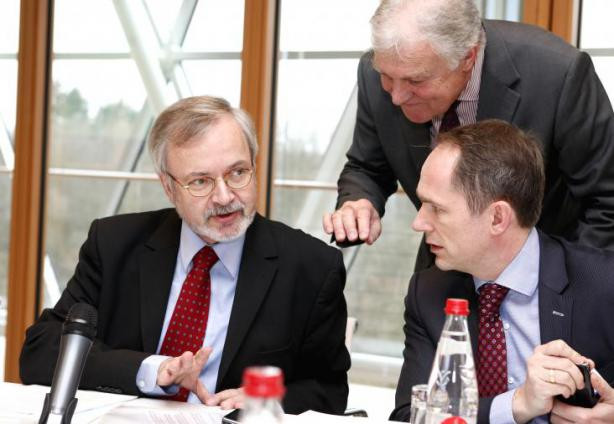
Then in September, the three organisations launched a second fund to “facilitate up to €750 million of new EIB funding in Greece,” to support infrastructure projects, which the EIB’s chief, Werner Hoyer (photo, left), said at the time is “crucial” in the effort to “overcome the crisis.”
The EIB employs about 2,000 staff and issues between €40 and 60 billion in loans annually. Although the bank raises its own capital--to fund infrastructure projects in line with Brussel’s policy objectives--it is backed by EU member states.
It has top-notch AAA credit scores from the three largest global ratings agencies, which Fitch re-iterated in September and Moody’s re-confirmed in August of this year. Large losses in its loan portfolio could potentially lower its credit rating and thus drive up the interest rates the bank pays.