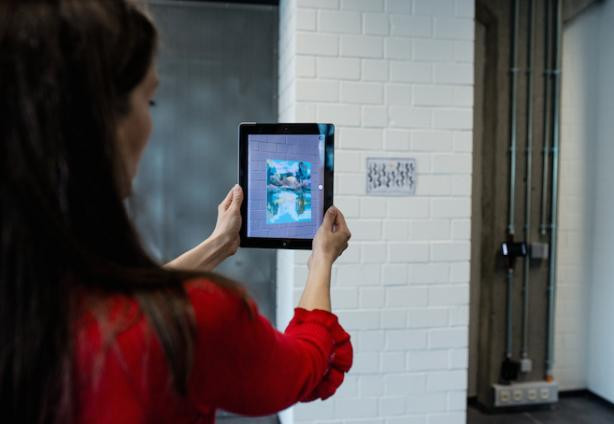
Art buyers typically face the same primordial question: what will the piece they are considering really look like when it is installed in the space they are considering? It is a challenge that Dirk and Karen Zadra tried to address hundreds of times during the decade they ran Galerie Zadra, which specialised in fine Aboriginal art, in Adelaide.
“I used to spend hours on the phone with clients talking about what could work,” recounts Karen. “It’s a very time consuming process. Or if they’re local, arranging for delivery and that’s expensive.”
Sometimes clients “sent us photos and we photoshopped [images of artwork] in, but it was never right,” explains Dirk. While searching for a product they could use at their gallery, they found “augmented reality” software and realised the technology was “much bigger than us; it’s a contemporary art solution. So we sold everything” to start a firm called itondo.
Test like Goldilocks
The startup makes an application that lets art shoppers view what a piece will look like in any given spot on an iPad or iPhone screen. They can do this while moving around the room in real time, and they can also save still images to consult later or share on social media. That means users, for example, “can see that work is too big for that particular space” or check if a smaller piece by the same artist would fit instead, reckons Karen.
The husband and wife entrepreneurs only moved from Australia in January to launch the app and website out of the Technoport in Esch-Belval, and itondo officially went live on 1 July.
It is free for consumers but when users first select an artwork, galleries or self-represented artists get charged “a very small amount”, says Karen. However “there’s only one charge for each painting,” regardless of how many times an art shopper views or shares it, states Dirk. “It’s a sales tool for galleries. They don’t have to pay a subscription fee or commission, which competes with [them]. We give them a different way to sell.”
Itondo is “a curated site, we’re checking if there’s a good standard of work” and they only work with professional galleries and artists, not hobbyists, she says. The firm launched with 11 “partners” (galleries and artists) in five countries, including the Krome Gallery in Luxembourg City. Karen and Dirk first want to build up their presence in the four main European art markets--Paris, London, Germany and Switzerland--before taking on New York and using their Australian connections to expand Down Under.
Using IT to make art accessible
That is one reason “why we chose [to set up in] Luxembourg,” he says. “We needed to be somewhere central, where there’s IT and there’s culture, and somewhere considered neutral” to avoid regional rivalries within the industry. Plus there are plenty of other international couples living here too (she’s Australian; he’s German).
At the moment, itondo works with two-dimensional work, such as paintings and photographs, although “we are hoping in the future to implement 3D so we could take on sculpture but it’s a question of the right technology,” says Karen. It is more time intensive and complex to scan pieces in 3D and end-users will need special software, which the firm is still developing, explains Dirk.
The ultimate goal is to “get more people living with art and giving them the confidence to buy original pieces of art,” says Karen. Because “a life without art to me is completely inconceivable.”