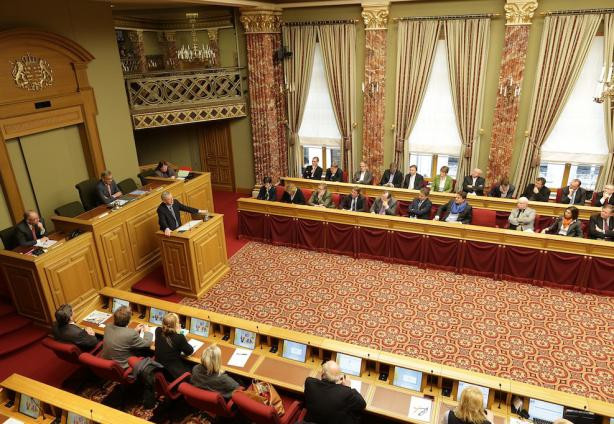
Many of the Luxembourgers who go to the polls on Sunday for the first time have only known one prime minister. Jean-Claude Juncker has been the leader of government since 1995 and is unwilling to surrender that position. He has been prime minister for longer than Margaret Thatcher or Tony Blair and political life in Luxembourg without Juncker at the helm seems almost unthinkable--or at least it did until one fateful day in June when, following a two-hour speech to parliament that failed to convince opposition parties and his own junior coalition partner, he avoided a no-confidence by calling early elections.
Five months on and the scandal of the parliamentary commission’s report into the workings of Luxembourg’s secret service, which held Juncker responsible for its neglectful mismanagement, has all but been forgotten. Or has it? The subject has barely been raised in official debate or party manifestos, but it still lingers in the minds of the electorate as the reason they are being called to vote for a new parliament eight months earlier than expected.
The difficulty for political commentators in predicting Sunday’s result is whether voters will blame Juncker for his apparent incompetence in handling the secret service and for promulgating what some have called the “CSV state”, or whether they blame the junior coalition partner LSAP--and, to a lesser extent, the opposition DP and the Déi Gréng--for attempting to bring down Juncker over what many see as a relatively minor matter when the Europe is still facing economic uncertainty.
With pre-election opinion polls last conducted a month ago, voter reaction to a series of debates between the leading candidates has been limited to informal and unreliable surveys of live audiences. The opinion polls in September seemed to suggest that the race will be tight, but that the CSV will once again prevail as the strongest party in parliament.
The problem it then faces is with whom should it try to form a coalition? Jean-Claude Juncker has openly said he would not rule out any of the other major parties as a potential coalition partner, and most Luxembourgers seem to think that the CSV-LSAP government will be returned to power. Indeed, a televised debate on RTL this week between Juncker and LSAP leading candidate Etienne Schneider appeared to show the two men warming to each other again after a summer of accusation and recrimination.
The most obvious alternative to a CSV led coalition would be a grand coalition featuring the LSAP as the dominant party together with the liberal DP and Déi Gréng. That is, according to a Politmonitor poll published mid-September, the most popular combination among those voters who want a change of government. But could such a broad coalition work?
The DP and Greens have, of course, been working in tandem in Luxembourg City since 2004 and DP poster boy Xavier Bettel has spoken of his admiration for LSAP leading candidate Etienne Schneider. He did, however, also question whether Schneider truly represented the “socialist” aspect of his party. Bettel, who is president of his party but only one of four leading candidates at the election (the DP chose one for each electoral region), has also stated that he will see out his mandate as mayor of Luxembourg City.
That may be a difficult commitment for Bettel to keep if the most “likeable” politician in the country (according to opinion polls--Juncker still leads, just, in the “competence” polls) leads his party to a position in which he is obliged to enter government.
As for the Greens’ François Bausch, the de facto leading candidate (even though the party has chosen to have two leading candidates--one of each sex--in each electoral region), as the author of the parliamentary commission of enquiry report into the secret service he is seen by many as the architect of the attack on Juncker in parliament--a problem of perception that could yet haunt his party.
The decision before the electorate seems to be whether to place trust in those familiar faces who have steered the Grand Duchy through years of prosperity (though many of the old guard are not even standing for re-election) or to seek a viable alternative from the relatively new candidates such as Schneider (who, lest we forget, has only been on government for less than two years).
Whatever the outcome of Sunday’s election, then, it may be some time before a government is formed and the negotiation process will require players on all sides to swallow some pride.