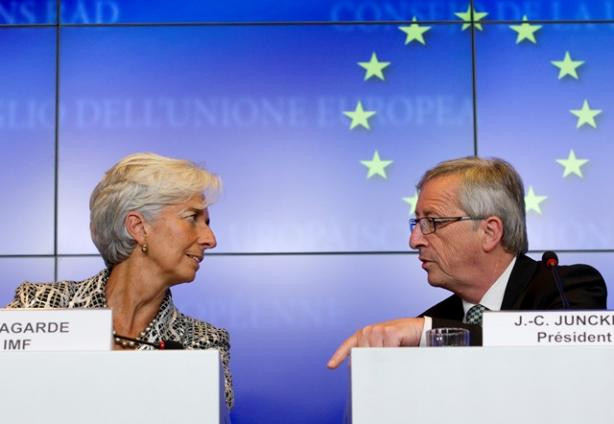
Greece, with its newly elected pro-EU government, was one of the easier items of the council’s agenda. Prior to Greek elections last weekend, European ministers had blocked the transfer of one billion euro in bailout funds to Greece’s government from the EFSF, the euro zone’s temporary rescue agency.
As a result of Thursday’s meeting, those funds will now be dispersed “before the end of this month,” Jean-Claude Juncker (photo, right), Luxembourg’s prime minister and head of the Eurogroup of euro zone ministers, said during a press conference.
The question of support for Spanish banks was more difficult. Ministers agreed that the so-called troika--the European Central Bank, European Commission and International Monetary Fund--will visit Madrid and report back to European ministers by July 9.
“The EFSF will be ready and will be able to support Spain very quickly and even with very large amounts,” said its CEO, Klaus Regling. “We gained experience in the case of Greece how to recapitalise banks without going to the market to raise large amounts of money.”
Yet uncertainties over the bailout operations remain. The EFSF was originally meant to wrap up operations next month and give way to a permanent rescue fund, the ESM, which--like the EFSF-- is expected to be based in Luxembourg. However, only eight of the 17 euro zone countries have ratified the necessary treaty.
The EFSF will continue to support Spain and the other euro zone members hit by the financial crisis until the ESM is up and running, explained Olli Rehn, the European economy commissioner.
Christine Lagarde (photo, left), head of the IMF, also attended the summit, where she pushed for greater integration of banking regulation, government budgets and sovereign debt within the EU. She said “common European supervision, which takes the form of bank resolution, which takes the form of deposit insurance of a euro area-wide nature,” was a top priority for the IMF.
“Principle number two is a fiscal union, more integration in fiscal terms, with risk-sharing supported by stronger governance.”
Referring to Eurobonds--which have often had different labels, but would essentially be backed jointly by all euro zone members--long opposed by Germany, Lagarde told the press: “you can call them projects, you can call them bills, you can call them bonds, but the principle of it is the sharing between the member states.”
Yet ministers barely broached such proposals and markets were left unimpressed.
Just hours after the press conference, one of the world’s largest credit ratings agencies, Moody’s, downgraded 15 of the world’s largest banks and brokerage houses--the largest financial institutions in France, Germany, Switzerland, the UK and US--citing the ongoing European debt crisis.
The summit will conclude on Friday.