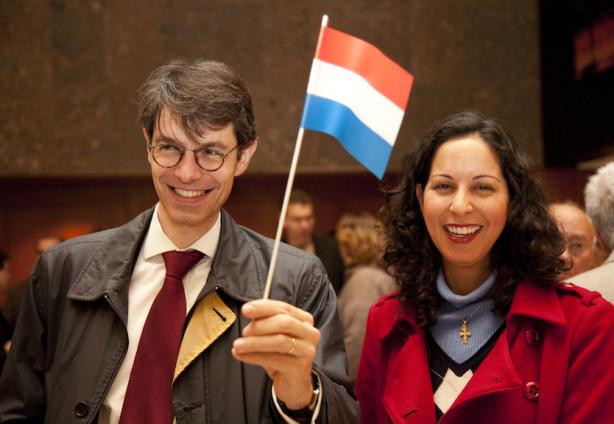
The draft legislation presented by justice minister Félix Braz in early October will make it much easier to obtain Luxembourg nationality, by lowering residency and Luxembourg language knowledge requirements. But it also includes provisions for obtaining nationality through marriage and by birthright, if certain conditions are fulfilled.
The most significant change is that applicants need only have proof of five years of cumulative residency in the Grand Duchy instead of the seven required under the current law. That term is even reduced to three years for residents who have completed the CAI Welcome and Integration Contract (which involves language and citizenship courses), as well as for those under the age 18, with refugee status or who are officially recognised as “stateless”. This distinction has already angered some commentators who say the law would effectively create two-tier citizenship.
The draft legislation will see compulsory civics courses extended from six to 24 hours. But it is the change in language requirements that has sparked the most controversy. The new law will lower the standard of both passive and active knowledge of Luxembourgish to level A2. Applicants who have lived in Luxembourg for at least eight years and have taken a minimum of 100 hours of Luxembourg language classes, as well as those over the age of 65 or who are deemed incapable, physically or mentally, of learning to speak Luxembourgish will even be exempt from taking the language test.
Riding roughshod
Comments via social media on reports posted by local news sites included some opponents labelling Braz a “Portuguese-Luxembourger”, and claiming that the government’s plans are riding roughshod over the will of the people.
On the other hand, many argued that Luxembourg has other more pressing problems to deal with and should welcome anyone who wants to become a citizen, while some even suggested that Luxembourgish is merely a dialect that many locals do not even know how to write correctly, and therefore language requirements are of secondary importance. One national, Steven Heer, of Portuguese and Belgian parentage, has even launched a petition (no. 564) to challenge the easing of the new law’s language requirements.
Criticism of the government proposals also rained in from familiar official quarters--notably the populist ADR party, the “nee2015.lu” group and the CGFP civil servants’ union. The “nee2015.lu” platform, which campaigned successfully against allowing foreigners the right to vote in national elections in June’s referendum, accused Braz of trying to give foreigners the vote by the back door.
But prime minister Xavier Bettel sprang to the government’s defence. In an interview in the Tageblatt, he said, “the electorate told us [in the referendum] that they did not agree that non-Luxembourgers should be given the right to vote for parliament. They did not voice their opinion on whether the criteria to obtain nationality should be made easier or more strict.”