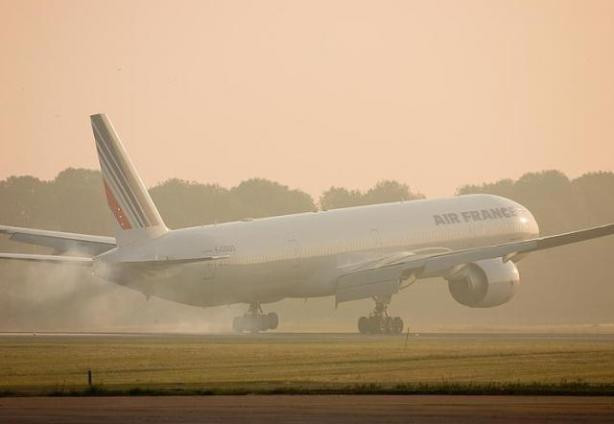
Passengers on connecting flights must be compensated if they reach their final destination late, even if the original flight left on time, the European Court of Justice has said.
Last autumn the court re-affirmed its ruling that air carriers in the EU have to pay compensation to travellers whose flights are delayed by three or more hours, as set out under EU rules, “unless the delay is caused by extraordinary circumstances”.
In this week’s case, Luz-Tereza Folkerts was booked to fly from Bremen, Germany, to Asunción, Paraguay, with connections in Paris and São Paulo, Brazil, in May 2006. The first two of the three flights were booked on Air France.
The Air France flight from Bremen to Paris left approximately two-and-half hours late, under the three hour rule, but late enough to cause Folkerts to miss her transfer to São Paulo and then the subsequent connecting flight to Asunción. She ultimately arrived in Paraguay 11 hours after her scheduled arrival time.
Folkerts brought a case against Air France in Germany and was awarded €600 in compensation, the maximum allowed under European law. The French airline appealed--arguing that all of flights involved departed under the three hour rule--to the German Federal Court of Justice, which in January 2011 asked the ECJ in Kirchberg if the EU regulations apply to each flight separately or an entire voyage.
Transfer delays
On Tuesday, Europe’s top court said the rules cover the complete itinerary.
The judges ruled that “compensation must be determined according to the delay beyond the scheduled time of arrival at the final destination, understood as the destination of the last flight taken by the passenger concerned.”
“The opposite approach would constitute an unjustified difference in treatment, inasmuch as it would effectively treat passengers of flights arriving at their final destination three hours or more after the scheduled arrival time differently depending on whether their flights were delayed beyond the scheduled departure time by more than the limits set out in the regulation, even though their inconvenience linked to an irreversible loss of time is identical,” the ECJ said.
The case is number C-11/11 (Air France SA v Heinz-Gerke Folkerts and Luz-Tereza Folkerts) and it now goes back to the German appeals court for final adjudication.
This is the latest in a string of rulings firmly in favour of airline passengers. In February, the ECJ ruled that Ireland’s largest budget airline Ryanair was responsible for taking care of stranded passengers after a 2010 volcanic eruption.
Last year, the court ruled that the price posted online for air tickets needs to reflect the “final price” and “optional supplements” such as cancellation insurance must be sold on an opt-in--not an opt-out--basis.