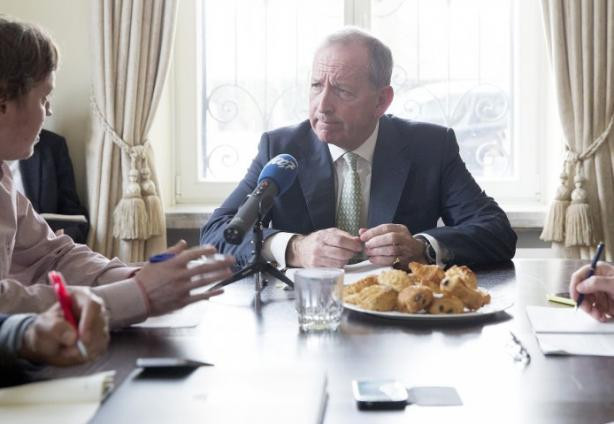
A UK exit from the European Union is unthinkable for the City of London. So says the man who represents the City’s interest, Alan Yarrow. As the lord mayor of the City of London, Yarrow was in Luxembourg this week to meet ministers, key officials and business leaders about Luxembourg’s forthcoming presidency of the EU council, which it takes up on 1 July.
But with the UK facing a general election in May, the consequence of which could be a referendum on the country’s membership of the European Union, Yarrow was keen to cite figures suggesting that 84% of the City’s stakeholders would like to stay in a “reformed” Europe.
Asked what impact a so-called Brexit might have on the City, Yarrow was forthright. “Can’t think about it. Anyone can speculate about what might or might not happen.” If, after the general election on 7 May, the UK has a Conservative led government, “we will have to contend with the possibility of a referendum,” he told journalists assembled at the residency of British ambassador Alice Walpole on Tuesday.
Yarrow said he thought that last year’s vote on Scottish independence showed that referendums are often overtaken by emotion rather than logical economic fact, which is an issue the City cannot answer. “What we can do is make it very clear that it is in the interests of the City and financial service that we have access to 500 million consumers, effectively, in Europe. We doing our best to make sure the right economic arguments are exposed for people to make their own decision on which way they vote.”
Common position
He also held discussions on issues of mutual interest to the Luxembourg financial services sector and the City of London, which counts some 387,000 of the two million people employed in financial services in the UK. He held talks with finance minister Pierre Gramegna on BEPS, FTT and TTIP and other issues on which the two financial centres have a common position.
“That is the most important thing about talking, you establish common ground. We respect Luxembourg as a competitor. You have a very nimble and fast moving and bright financial industry. But equally, it is a very large market and there is enough room for us both to survive. And we are complementary in a lot of things that we do.”
Rebuilding trust
Yarrow readily admits that the City made mistakes, right across the board, during the financial crash and that the City recognises it has to put those mistakes right. “The important thing is to rebuild trust in the financial system. We believe, and I believe personally, that after Basel II, when there was an acceleration of money supply… we saw people were putting themselves first before their customer, and there was also an indication they were putting themselves before the shareholder and trying to take benefit from the upside without taking commensurate share of the downside of the risk.”
Yarrow called such behaviour “unacceptable” and said that it was not compatible with the future of the City of London. “It’s going to take a long time to reverse what’s happened, but I do believe that we have the right regulations in place to try and improve that responsibility.”
The lord mayor is a non-political position and is the formal chief of City of London, the 1.12 square mile (2.90 square kilometre) “quartier” that is home to a significant number of major financial and legal firms. The lord mayor also has an official if symbolic role in UK diplomacy. The elected mayor of London is currently Boris Johnson.