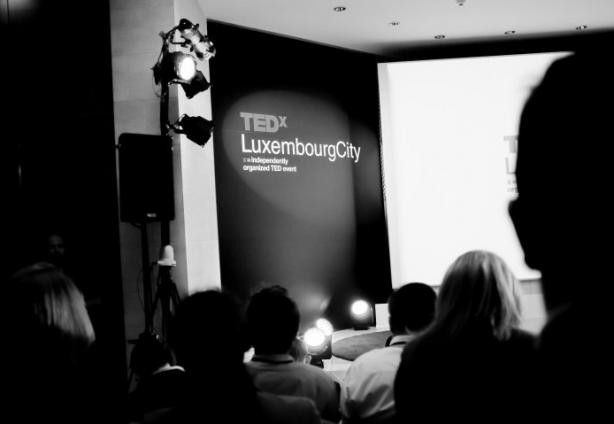
TEDxLuxembourgCity 2013, held March 6 at the Mudam, featured 16 speakers, live music and video talks from TED. This week conference volunteers Ema Kazlauskaite and Snezhina Kovacheva contribute their summary of the live presentations.
Jean-Claude Schlim: “Staying alive with AIDS”
Luxembourgish film-producer Jean-Claude Schlim considers his critically acclaimed film “House of Boys” as a contribution to talking about HIV/AIDS, which is still related to tremendous taboos, especially with regard to the perception of people living with HIV.
Beyond a well-informed account of the history of AIDS, Jean-Claude talked about a disturbing statistic--that some European countries are experiencing the highest infection rates since the arrival of AIDS three decades ago. In this context, Jean-Claude--a survivor himself who was diagnosed with AIDS in 1989--considers it his artistic duty to awaken a most urgent consciousness within disengaged younger generations, and to provide them with the painful but necessary historic background about HIV/AIDS.
Jean-Claude’s open, honest and moving account about his life with AIDS finished with a courageous quote by Rock Hudson:
“I am not happy that I am sick.
I am not happy that I have AIDS.
But if that is helping others,
I can at least know that my misfortune
Has had some positive worth.”
…and brought the audience to a long ovation.
Watch the video of Jean-Claude Schlim’s presentation >>
Marie Müller: “Moving to Victory Street”
Marie’s story is incredible, to say the least. After closely missing the historic chance of winning a bronze medal for Luxembourg at the 2012 Summer Olympics, after the nerve-wracking decision-making process by the jury, Marie had to deal with how much that hurt, while she had been consistently trained as a sportswoman to “never show weakness”.
Marie walked the audience through a complicated journey in the Olympics’ aftermath: she felt like the loneliest person in the world when she learned about the jury’s decision. She still cannot watch the fights or see the pictures. Her first reaction was to show strength in facing the defeat, and be okay in front of her family and friends who were so sad. She could not cry in front of her loved ones, or show how broke and still she was inside.
One needn’t have competed in the Olympics to empathise with how challenging this must have been for Marie. On the bright side, she has just moved to Victory Street (rue de la Victoire), and is changing the feelings from losing something big into motivation to try reaching “my new dream--an Olympics medal.”
Watch the video of Marie Müller’s presentation >>
Jasper Bergink: “For a state of happiness”
Jasper led the audience through a number of shrewd questions to lead us to question whether economic growth, gross domestic product and obsession with productivity can indeed be sufficient and adequate measures, which would bring us to a state of happiness.
Not really, according to Jasper, who maintains that such measures “capture very little of what makes life worth it”. Instead, he talked about Gross National Happiness--the main concept informing all policy decisions in Bhutan, which boldly attempts to get closer to “measure what is truly worthwhile,” including positive emotions and hours of sleep, to mention a few components.
Jasper called the audience to choose to go down “Happy Road,” to enjoy the current moment, to appreciate what we have and to focus on what matters. Only then we can turn our state into a state of happiness.
Watch the video of Jasper Bergink’s presentation >>
Brian Mengwasser: “Our energy lifeline from the stars”
Brian took the audience through an inspiring and challenging proposition--to look to the stars to generate sustainable energy for our future, and to harness the sun directly and continuously, straight into space, and beam it down to the Earth’s surface.
Brain started by positing the reality of climate change is no longer a question. Rather, we should ask ourselves about the impacts. We must overcome our collective denial, and to acknowledge that climate change cannot be solved via conventional means. We must also acknowledge that we cannot generate all of our energy sustainably at present, or keep up with the increasing pace of energy demand powered by global demographics and a technological glut.
Brian pleaded for courage at all levels to reach to the stars to power our future, and to create a legacy we can be proud of.
Watch the video of Brian Mengwasser’s presentation >>
More on the conference can be found on Delano’s TEDxLuxembourgCity 2013 page.