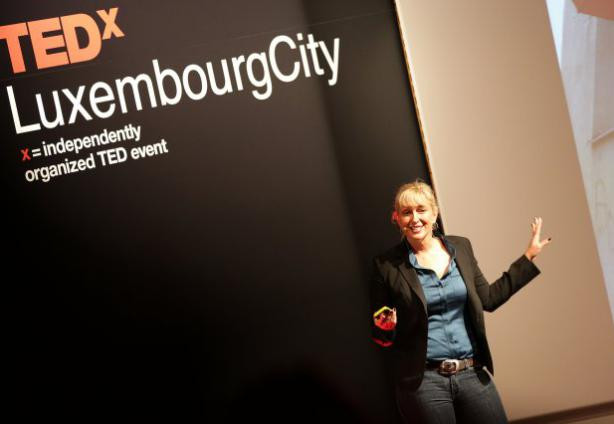
TEDxLuxembourgCity 2013, held March 6 at the Mudam, featured 16 speakers, live music and video talks from TED. This week conference volunteers Ema Kazlauskaite and Snezhina Kovacheva contribute their summary of the live presentations.
Jennifer Rawlings: “The courage to forgive”
Jennifer Rawlings is Los Angeles-based writer, comic, filmmaker, and kick-ass mom. Her versatile interest and talents have taken her to all corners of the world. She touched the lives of many soldiers on the ground, even if for a second with a laugh or a smile, and she was equally changed by the experience.
Jennifer shared three poignant stories with the audience--about a 19-year-old disfigured soldier in Afghanistan; a Bosnian mother whose son died nine years after the Bosnian war was over when a grenade exploded in the hands of his schoolmate in a supposedly landmine-free area, and about a woman from Darfur and her hope for a better post-war life.
Jennifer talked passionately about the type of courage derived not from our strength, but from vulnerability; about the courage to forgive and to move on, rather than continue carrying hatred in one’s heart, after a traumatic experience.
Jennifer urged the audience not to remain passive at the sight of a conflict-ridden world, but to dare to change the world one story, one conversation and one person at a time.
Watch the video of Jennifer Rawlings’ presentation >>
Françoise Hontoy: “Just do it--change your fears”
Françoise considers herself an enabler. She wants to see other people achieve their goals. What is holding us back and what makes us move forward, she asks. To take action, we need courage, and one often suggested solution is to wipe fear away. Françoise maintains we should know what we fear, before we can wipe it away or overcome it.
Between courage and fear, it is the fear that comes first, as a deep-rooted human reaction. In a dangerous situation, before the adrenaline rushes in, we freeze to decide if we run or fight. Fears can protect us, and we deal with them all the time, from toddlers to adults.
And when the adrenaline rush is not enough, “just do it”, Francoise suggests. Take inspiration from toddlers, who continuously try and fail until they succeed.
Instead of trying to recover from failures independently, understand the environment, the facts and all things which are relevant. To overcome the feeling of being “stuck”, ask yourself: “What do I fear?” Knowing and understanding your fears gives you the freedom to Just Do It.
Watch the video of Françoise Hontoy’s presentation >>
Stephan Kinsch: “Why your inner clown's the better leader”
Stephan--whose objectives throughout his life included becoming a great leader, manager, boss, coach, father, husband, friend, musician, trainer and artist--light-heartedly shared an inspiring story how he discovered his “inner clown”.
Stephan talked about his traumatic and challenging first encounter with a “real” clown at a clown workshop, where he had to start learning how to express his feelings. Gradually, Stephan--who at the beginning of his talk labelled himself an “arrogant, selfish and possessive person”--learned to become more respectful, collaborative and tolerant, and “give the clown some place in my life”.
Stephan then went ahead to share a few tips we can all learn from:
Humour is when you are happy because others laugh because of you.
Bosses who can laugh at themselves are more trustful.
The Clown is an opponent to the system--you can ban him or listen to the truth he will tell you.
Experience has taught Stephan that--in order to become a great leader, manager, boss and all other roles in life one wishes to fulfil--he needs to listen to his clown.
Watch the video of Stephan Kinsch’s presentation >>
Katy Fox: “Courage and Connection”
Social anthropologist Katy Fox talked about connection as a key condition of life, and about the world as a deep interconnected place and one that exists due to the quality of relationships that shape it.
Katy shared a moving story about her time as a doctoral researcher exploring the impacts of EU agricultural policy on the lives of subsistence farmers in Romania, where she experienced moments of deep connection with members of the local communities she was visiting. She also talked about founding the Centre for Ecological Learning Luxembourg, which intends to make the world a more resilient place, by redesigning our landscapes through ecological design.
Katy believes the way, in which we can counteract the tendency toward disconnection, is through practicing--in our everyday gestures--small acts of courage, which are fundamentally acts of connection. And such moments of connection only come when we acknowledge vulnerability and interdependence.
If we think in such terms about the world, we can come much closer to having a healing relationship with the people around us, and with the world.
Watch the video of Katy Fox’s presentation >>
More on the conference can be found on Delano’s TEDxLuxembourgCity 2013 page.