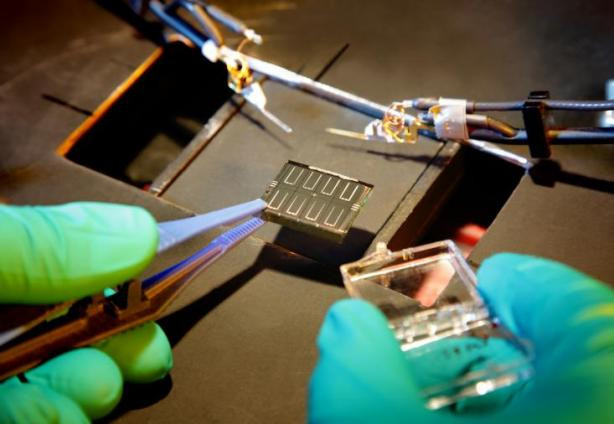
The unit’s research focuses on extremely small-scale structures that can be used to make electronics and building and manufacturing materials, and to deliver pharmaceuticals inside the body.
The scale of the public research centre’s cleanroom and equipment means the lab can tackle real-world challenges, Dr. Damien Lenoble, head of Lippmann's nanomaterials research unit, told Delano. “The sizes of the samples that we can process and play with are relevant enough for [technology] transfer to industry.”
While the inauguration ceremony took place on Thursday, the lab has already begun operations. It currently has eight research projects in the works, four with private partners and four backed by Luxembourg agencies including the national research fund FNR, Lenoble said. “It’s quite an important day for us since we want to demonstrate the capabilities that we have and the effort by the [research] ministry in supporting nanoscience in Luxembourg.”
“There are very few research labs in Luxembourg, so it’s important to create this sort of centre,” Professor Albert Fert of the Université Paris-Sud, who was keynote speaker at the inauguration ceremony, explained to Delano. “It’s also a chance for the University [of Luxembourg]. If you want to develop the university... then it’s important for the students to have, in the same country, research and development labs and also a corresponding industry.”
Fert--who received the 2007 Nobel Physics Prize with Peter Grünberg--said he almost always refuses invitations to such ceremonies, but was please to attend given his connections with Luxembourg researchers and what he knew about the Lippmann project.
He also calls support for nanoscience research one of the keys for securing the developed world’s economic future. “Europe must remain competitive in this field. The competition with Asia will become harder and harder.”