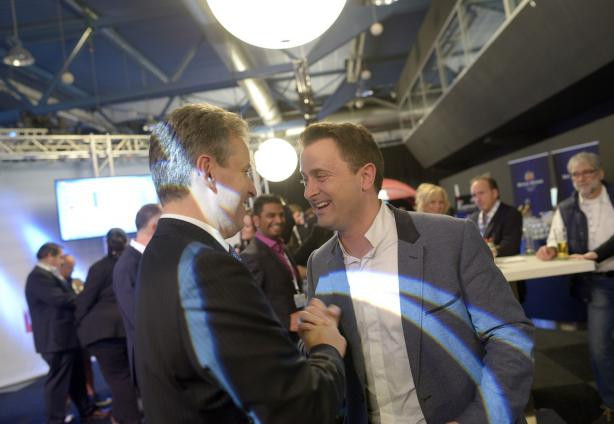
“If a coalition is formed without participation of the DP, then there is no point in voting.” Speaking with what some called his game face on, DP lead candidate and party president Xavier Bettel showed his determination last night to be at the centre of negotiations to form the next government following his party’s surprisingly strong showing at the polls on Sunday. “It is a dream result,” Bettel said in an interview with the Luxemburger Wort.
The liberal DP gained votes across the country and added four parliamentary seats to the nine it had before the election. The only other party to gain in parliament was the left wing Déi Lénk, which now has two seats, while the ruling conservative CSV lost three seats and Déi Gréng, the green party, lost one seat. The socialist LSAP, the junior coalition partner in the last two governments, remained stable in terms of parliamentary seats but saw its share of the vote plummet to its worst since the 1999 elections.
Indeed, the election results are reminiscent of those 1999 elections when the DP gained ground at the expense of the LSAP and CSV (although the right wing ADR also won 2 seats) and the Déi Lénk (then fighting its first election) also won a seat.
Decisions, decisions, decisions…
Bettel and his party must now decide whether he will sit down with the CSV and discuss forming a coalition, or whether he will attempt what many see as the impossible task of forming a three-way coalition with the LSAP and Déi Gréng.
In terms of finding common ground for a government programme for the next five years, that constellation would have been tricky enough had all three parties gained ground--but with the socialists and greens both seeing their share of the vote fall, it becomes even more difficult to justify such a move to the electorate. Bettel said on Sunday that he would want to be in a coalition that would allow the DP to achieve many of the policies it had spelled out in its manifesto.
On the other hand, the opposition parties could argue that the CSV has seen also its share of the vote and its representation in the chamber of deputies fall quite dramatically. Yet, the fact remains that the conservatives under Jean-Claude Juncker still retain 23 seats in parliament--their third best showing in the last 30 years.
But Bettel, whose personal result proved that he is the most popular politician in the country, has hinted in the past that he would only give up his mandate as mayor of Luxembourg city if the nation indicated that it needed him--in other words if he were to be prime minister.
That ambition could only be achieved in a three-way coalition. But a coalition with two parties who have failed to gain popular support may not survive its five year mandate and that could damage the DP in the long run.
Then again, the last time the DP entered a coalition with the CSV, in 1999, it was decimated at the elections five years later, losing five seats. He may have been all smiles in the afterglow of victory on Sunday night, but the choice now lying before Xavier Bettel and his DP executive colleagues is a tough one.